Three Outboards, One Lever: Mercury's DTS
The evolution of digital throttle and shift controls continues with Mercury's Shadow Mode.
A friend recently took a demo ride on a new offshore center console boat rigged with triple Mercury Verado 300 motors. He left amazed not by the features of the boat or the performance of the motors, but by the Mercury DTS (Digital Throttle and Shift) controls that were part of the package, particularly the Shadow Mode element that let him throttle all three motors with one lever.
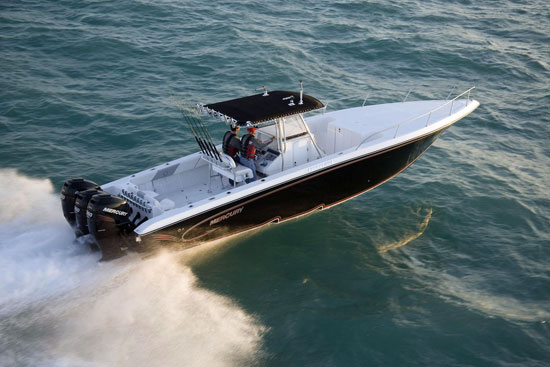
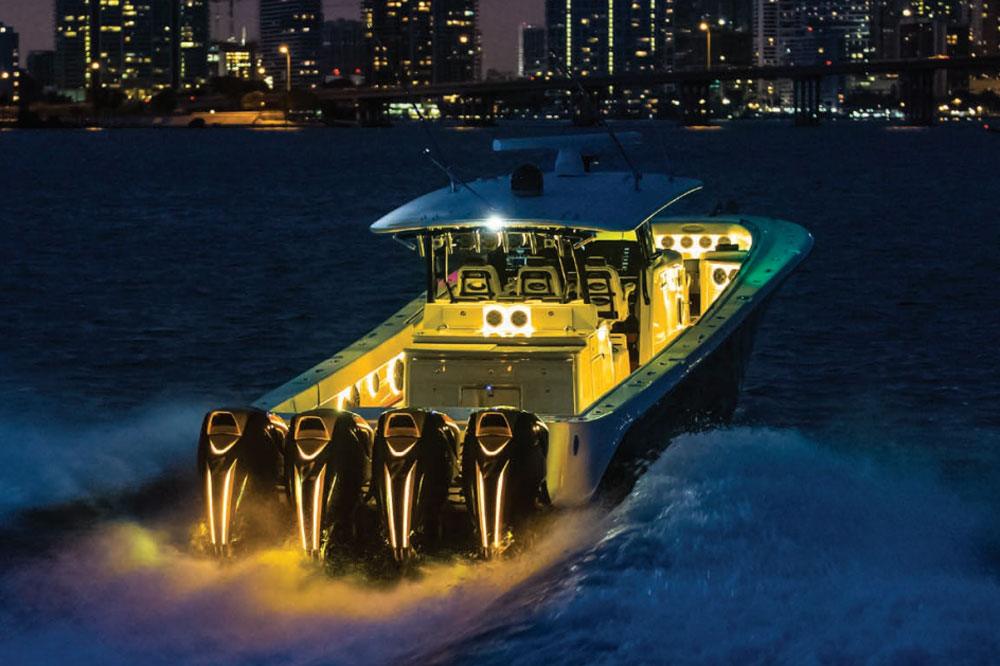
Digital controls make it possible to pilot a high-performance, multi-outboard rig like this Fountain with a single control lever.
“This is amazing technology,” he enthused over a beer that evening, as excited as a kid with a new Transformer. “One lever. Three motors! What’s next?”
Amazing yes, but not new. Merc introduced DTS with Shadow Mode for triples in 2005, and for quads in 2006. The ability to throttle and shift multiple engines with one lever was added in 2007. And that was the last time I reviewed this system. But since then Merc has added some new features, and if my buddy didn’t know about Shadow Mode, maybe you don’t either.
Mercury introduced DTS as an integral part of its Verado line in 2004, and today offers digital controls on Verado from 135 to 350 horsepower, the broadest range of any manufacturer. DTS is a “fly-by-wire” system that replaces mechanical cables with wires that carry an electrical signal from the control to the ECU (electronic control unit) on the outboard, which in turn controls an electronic throttle actuator, and solenoids that handle shifting. Digital controls offer a multitude of advantages. You’ve replaced cables that can stretch or corrode, of course, but because the system is electronic, all kinds of other features can be built in, from a mode to adjust engine speed in fine increments for trolling to automatic engine synchronizing, features offered on Merc digital controls and those from Yamaha, BRP and Suzuki.
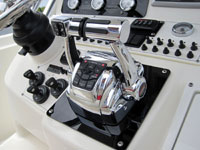
Just one lever of this Mercury DTS control can throttle and shift four Verado outboards in unison. Buttons to manage other functions are located on the pad in the control binnacle.
Those other builders also offer twin-lever digital controls that can throttle three or more outboards – the new Evinrude control can throttle five motors. Those systems “slave” the inner motors to one of the outer motors. The Merc Shadow Mode is different in that the ECU throttles the center engine or engines to the average rpm of the two outer engines. When I asked a Merc rep why they went with the averaging idea, he just shrugged and said that it seemed like the logical way to do it. But it also results in the most-balanced thrust across the transom when the motors are slightly out of sync. Which, of course, should not happen if the Auto Sync mode is engaged by pushing that button on the control base. If either the port or starboard engine were to go off-line, the center engine would simply slave to the remaining outboard engine. To slow troll on just the center engine, you would start the center motor, key the port motor to “on,” and then throttle and shift with one lever.
Another feature offered only by Mercury is Docking Mode, which is also engaged by simply pushing a button and has the electronic effect of reducing the throw of the levers. This gives you finer control of engine speed in tight quarters, and reduces the possibility of accidentally getting a big burst of Verado power if a lever is bumped or just “over-applied.” Mercury has also upgraded its DTS to the NMEA 2000 standard, so it can communicate with aftermarket NMEA 2000 navigation displays.
What new tricks can we expect to see in digital outboard controls? I’m betting the integration of an automatic trim system that would respond to boat running angle and throttle setting. Or at least trim the motors all the way down when you throttle back to idle speed. We’ve already got similar technology for trim tabs. Here’s another idea. Integrate the Merc ECO-Screen fuel economy monitor so that it automatically selects a throttle and trim setting for optimal fuel efficiency. So all I have to do is steer.