Cabo Rico 38 Used Boat Review
Onboard a hard-to-find Cabo Rico 38.
September 18, 2000
Skim any brokerage listings and you'll rarely find a Cabo Rico 38 on the market. That's because more than 80 percent of the original owners still own their boats. This one fact is particularly telling about the level of owner satisfaction, since the boat was introduced more than 15 years ago. Besides, Cabo Rico executives admit that they aren't sure where many of the rest of the owners are, because so many Cabo Ricos are cruising the world and are out of touch.

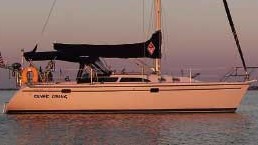
The Cabo Rico 38 was designed by W.I.B. "Bill" Crealock.
The Cabo Rico design hasn't succumbed to the fickleness of style and remains just as pretty today as it was when it was first introduced. The clipper bow with spirit is distinctive in any anchorage, the stern is pretty without being truncated, and the sheer is what old timers still call "sweet."
Underwater, there's a long keel to help the boat track across endless miles of open ocean, with just the hint of a cutaway forefoot to provide maneuverability in close quarters. The unbalanced rudder is well protected from groundings by the keel, and the propeller is hidden in an aperture. With such a traditional design, it's no surprise that there are no bumps or hollows to meet some transitory racing rule, and the underwater lines are clean and fair. The result is a hull that sails well in light air, that can make long passages in good time and, surprising for such a solid cruising design, can climb to windward as high as 32 degrees relative.
Some touches, like the carved trailing boards, are pure decor, while the molded in rubbing strakes are clearly intended for protection from piers in faraway lands. The raised bulwarks that surround the deck also allow a sense of security in addition to providing a way to raise the stanchion bases out of the waterways.
Built in Costa Rica, each Cabo Rico is semi-custom finished to the specifications of each owner, although there are three basic layouts used as starting points. Depending upon whether an owner is planning long offshore voyages with a small crew and maximum storage or weekending with family and friends, the capacious hull can be tailored to any need.
Construction is surprisingly husky, particularly when compared with other so-called "offshore" yachts. The ballast (in several chunks) is fully encapsulated in and protected by the solid fiberglass hull, which uses endless layers of 24-ounce woven roving to build strength and thickness. No wood is used below the waterline, and balsa is laid inside the hull as insulation against sweating in cold or humid climates.
The mast is stepped on a heavy fiberglass and aluminum bridge that spans the hull to keep the aluminum spar and step from contacting bilge water. All the floor stringers, transfers and sub-flooring are fiberglass, so there is complete protection from rot. The hull-to-deck joint is massive, with a shoebox-type joint that combines 3M 5200 sealant/glue with stainless-steel through-bolts and aircraft lock nuts (all of which are accessible from inside the boat). Bulkheads are tabbed to the hull with both mat and roving, and aluminum backing plates are used for all deck hardware. The result is an exceptionally well-built yacht.
The high aspect cutter rig carries 90.0 square meters (969 square feet) of sail in an easily managed sail plan that is ideal for cruising. With the optional roller furling foresail, it's simple to reduce sail to just staysail and main, leaving the boat well-balanced to handle all sea conditions. The rig is oversized, with a single-spreader rig supported by two intermediate, two upper and four lower stays, and you can expect this tree to stay up in all conditions.
The cockpit is large enough for weekend sails, but the footwell isn't so large that you need to worry about being pooped by breaking seas offshore. Edson pedestal steering is standard, and two lockers are under each seat for stowing sails or installation of an optional generator. A bridgedeck protects the companionway in foul weather, and four steps lead to the warm and inviting cabin.
Cabo Rico has access to the immense Central American teak forests, and it has taken full advantage with interiors that are fully teak lined. In fact, you'd be hard pressed to find any bare fiberglass unless you pulled up the flooring. Even better, this isn't the dark teak often found on European and Asian-built boats, but a warm golden tone that keeps the interior bright.
In all layouts, the galley is to port at the foot of the companionway, with a U-shaped arrangement that gives good bracing. The double ice box is in the island at the forward side, the two-burner stove/oven is outboard, and a double sink is aft with extensive storage surrounding the galley. There's plenty of counter space for working, yet the cook is handy to the cockpit while still out of the way.

The Cabo Rico 38, in plan view.
From this point, the interiors tend to vary somewhat. All have a nav area to starboard, a settee with dinette to starboard with another settee to port. The head compartment, with separate stall shower, remains forward of the mast to starboard, and the forward stateroom has an offset double berth with seat and hanging locker. By juggling the size and location of the dinette and nav station, the standard layout gets a double quarter-berth to starboard, and the Convertible Aft Cabin model adds an enclosure around the nav station and quarter-berth that can be closed for privacy using sliding panels and door.
For an offshore boat, I would have liked at least one pilot berth, particularly in the Custom Offshore layout, which substitutes an expanded nav station and wet locker for the quarter-berth. This leaves the offwatch to sleep either in the forward stateroom (sometimes difficult offshore) or on one of the settees.
Power is a Yanmar M50 diesel with freshwater cooling, driving an 18- by 10-inch three-bladed bronze prop through a Hurth freewheeling transmission.
Under sail, the Cabo Rico 38 was surprisingly nimble, responding quickly to the helm but generally paying no attention to waves or wind direction. There's no doubt that it wouldn't be much strain on the crew during long passages, which is one reason the Cabo Rico 38 has developed a reputation as being ideal for singlehanders and couples.
With the divided rig and an optional self-tacking boom on the staysail, the 38 was easily tacked without hesitation, even in light airs and sloppy seas. Under power, it backs reasonably well in spite of the prop torque, thanks to the long keel and effective rudder position.
All in all, the Cabo Rico 38 should be on the short list of anyone planning to head offshore, whether going over the horizon or just to the next harbor.
Boat Specifications
| LOA | 12.49 m (41') |
| LWL | 8.91 m (29' 3") |
| Beam | 3.50 m (11' 6") |
| Draught | 1.52 m (5') |
| Displacement | 9.52 tons (21,000 lbs.) |
| Sail Area | 90.0 sq. m (969 sq. ft.) |
| Engine | Yanmar M50 50-hp diesel |
| Fuel | 189.3 liters (56 gal.) |
| Naval Architect: | W.I.B. Crealock |
Although the 38 is not still in production, Cabo Rico does still build models from 36 to 56 feet. For more information, visit Cabo Rico.
Editor's note: this article was updated in July of 2017.