Eliminator 30 Daytona: Powerboat Performance Report
Eliminator 30 Daytona: Log some flight time.
January 22, 2005

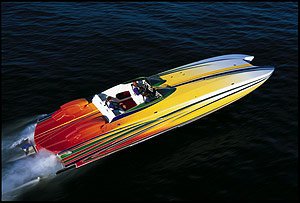
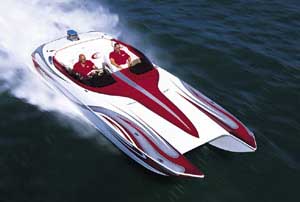
At 120 mph, a speed it took less than 20 seconds to reach from a standing start, the cat felt comfortably connected to the 6-inch chop on Mission Bay. (Photo by Tom Newby)
It says something about the current state of speed on the water when, on the first day at the first leg of the 2005 Performance Trials, the first boat on the water tops 140 mph—and had more to give. That's exactly what happened on a fine, late-September day in San Diego when we ran the Eliminator 30 Daytona.
Though we always respect that kind of speed, we weren't surprised by it. The catamaran reportedly topped 150 mph at the Bridge-to-Bridge event on the Sacramento (Calif.) River Delta a few weeks earlier. But to run 140 mph in the first boat on day one of the Trials, knowing that in the coming weeks there would be faster boats to come? Impressive.
Performance
With the release of the 19 Daytona in the early 1970s, Eliminator founder Bob Leach introduced the "recreational" tunnel boat to the West Coast market. Though the 19-footer remains in the line, the Daytona series now includes catamarans up to 36 feet.
The middle child in Eliminator's cat family, the 30 Daytona rides on two stepped sponsons and a center pod. To handle the gear-shredding horsepower and torque from the twin 572-cubic-inch, supercharged engines from Semper Speed & Marine in Fresno, Calif., Eliminator outfitted the cat with 1.25:1 reduction IMCO Xtreme Advantage 4 x 4 SC drives. Propellers were lab-finished Bravo One 15 1/4" x 36" four-blade stainless-steel models from Mercury.
Equipped with quad-rotor superchargers from Whipple Industries, the Semper Dart-block-based engines ran smoothly, though they did tend to cut out at idle speed. Before we ran out of water on Mission Bay, we were able to push them to 6,000 mph, which was good enough to produce a speed of 141 mph. There was a good bit of throttle left, probably 500 to 700 rpm and the boat definitely could have gone faster.
Certainly, the 30 Daytona displayed the requisite stability for high-speed running. At 120 mph, a speed it took less than 20 seconds to reach from a standing start, the cat felt comfortably connected to the 6-inch chop on Mission Bay. It felt solid, if a touch lighter, at 140 mph.
Standing-start acceleration tests are brutal on drives, especially when you're dealing with 1,150-hp engines. To their credit, the IMCO drives handled the punishment without a glitch. With its Dana tunnel tab down, the cat came on plane in 4.7 seconds and reached 93 mph in 15 seconds. Fun stuff.
Even more of a blast were the 30 Daytona's midrange fireworks. The cat sprinted from 30 to 50 mph in 3.4 seconds, 40 to 60 mph in 3.7 seconds and 40 to 70 mph in 5.2 seconds. Would-be drag racers who pull alongside this cat beware.
The 30 Daytona held a level attitude in mid- and high-speed turns. Outside lean was minimal and tracking was true at all speeds. Because the engines produced so much torque, the cat tended to pull to the left during sudden deceleration, but it wasn't alarming.
Workmanship
Ingredients in the 30 Daytona's lamination recipe included vinylester resin, 1708 and 1808 Knytex knitted fiberglass, Coremat, end-grain marine-grade balsa and micro-lam stringers. Like most Eliminator models, the boat also is offered in a composite version for an additional charge.
In typical West Coast style, the builder handled the boat's graphics in the gelcoat—and the execution was excellent. Lines were clear and crisp, and there were no waves or pits in the mold work.
A striking touch, the IMCO drives were color-keyed in silver paint to match the boat's custom pewter bilge vents, grab handles, bezels and previously noted tunnel tab from Dana. To dress up the boat's six Accon Pull-Up cleats, the builder mounted them with pewter bezels.
Covering the fully tabbed joint between the hull and deck was a competently installed plastic rubrail. The Integrated Cockpit Canopy deck, tagged ICC by the builder, included acrylic quarter-canopies that fit neatly into dedicated recesses.
A pair of electric screw jacks took the work out of hoisting the substantial engine hatch, which had two fiberglass scoops. To make sure the engines stayed put, the builder through-bolted them to the stringers with L-angles and backing plates. Working space in the compartment was tight, as you'd expect in a 30-footer with twin big-blocks. Though the wiring quality was strong, a couple of cables—most notably the shift cable—needed better support.
Interior
Eliminator covered all the basics in the 30 Daytona's cockpit, which was outfitted with a four-person bench and muscular bucket seats. There was a stowage locker under the bench, as well as one in the sole, which had a hinged lid covered by its own section of snap-in carpet. Another carpet segment covered the cockpit sole.
With lots of Auto Meter instruments to install and not a lot of dash in which to install them, the builder used space ahead of the co-pilot's position to port to hold boost, fuel and volt gauges. Naturally, the gauges were installed in bezels angled toward the driver for better visibility. Also in the co-pilot's dash was a glove box. A grab handle was installed on the port gunwale.
The rest of the gauges were on the driver's side flanking a tilt steering wheel. The instruments were grouped by engine, and the rocker switches for the accessories were arranged in a straight line below them. Bluewater mechanical trim indicators were supplied for the drives and tab. Color-matched to the hardware, throttles and shifters were from Marine Machine.
For a 30-footer, the 30 Daytona had a surprisingly roomy cabin. Credit the spacious feel to a lack of clutter or amenities beyond facing lounges, a rectangular berth and flush-mounted interior lights.
Overall
With the 140-mph 30 Daytona leading off our 2005 Performance Trials, it's safe to say that, literally and figuratively, we're off to a fast start. And from the catamaran's high-speed handling to its high standard of construction, it's also a very solid start. That's what counts.
Hull and Propulsion Information
| Centerline | 29'10" | |
| Beam | 9' | |
| Hull weight | 6,800 pounds | |
| Fuel capacity | 160 gallons | |
| Engines | (2) Semper Speed and Marine 1150 hp EFI | |
| Cylinder type | V-8 | |
| Cubic-inch displacement/horsepower | 572/1 | 150 |
| Lower-unit gear ratio | 1.25:1 | |
| Propellers | Mercury Bravo One lab-finished 15 1/4" x 36" |
Pricing
| Base retail | $149,939 |
| Price as tested | $368,968 |
Options on Test Boat
Upgrade to Quad Rotor EFI 1,150 hp motors ($117,000), IMCO Xtreme Advantage 4 x 4 SC drives ($30,422), Extreme trailer ($25,130), IMCO standoff boxes with hydraulic steering ($13,610), gelcoat upgrade ($4,500), Auto Meter monster gauges ($4,360), TCM fuel-oil-water kit with stainless lines ($3,600), engine rail kits and diamond plate ($3,600), Dana Marine tunnel tab ($3,440), low-profile hatch scoops ($3,000), IMCO mufflers ($2,600), custom cover ($2,342), Bluewater mechanical panels ($2,310), sea strainers ($2,200), custom engine and drive paint ($2,000), lab-finished props ($1,950), Marine Machine shifter ($1,750), cabin door ($1,500), additional gauges ($1,280), Zeiger tilt helm ($1,275) and Bluewater trim indicator ($1,160).
Acceleration
| 5 seconds | 35 mph |
| 10 seconds | 58 mph |
| 15 seconds | 93 mph |
| 20 seconds | 125 mph |
Midrange Acceleration
| 30-50 mph | 3.4 seconds |
| 40-60 mph | 3.7 seconds |
| 40-70 mph | 5.2 seconds |
| Time to plane | 4.7 seconds |
| Minimum planing speed | 22 mph |
Rpm vs. Mph
| 1000 | 9 mph |
| 1500 | 12 mph |
| 2000 | 32 mph |
| 2500 | 45 mph |
| 3000 | 57 mph |
| 3500 | 74 mph |
| 4000 | 89 mph |
| 4500 | 104 mph |
| 5000 | 116 mph |
| 5500 | 129 mph |
| 6000 | 140 mph |
Top Speed
| Radar | 141 mph at 6000 rpm |
| GPS | 141 mph at 6000 rpm |
Test Conditions
| Site | Mission Bay San Diego |
| Temperature | 79 degrees |
| Humidity | 44 percent |
| Wind speed | Light and variable |
| Sea conditions | 6" chop |
| Elevation | Sea level |
For More Information
Eliminator Boats
Dept. PB
10795 San Sevaine
Mira Loma, CA 91752
951-681-1222
www.eliminatorboat.com.