Perry Design Review: Atlantic 46
Performance machine and cruiser
August 25, 2000
Chris White's Atlantic series of catamarans is an attempt at preserving the true speed potential of the catamaran while developing a comfortable cruising interior.
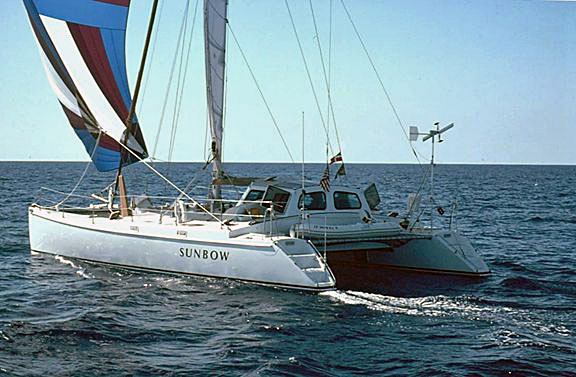
The Atlantic 46 catamaran.
Big cruising cats are often slower than their monohull counterparts. Unweatherly and loaded with wetted surface, they are painfully slow upwind and a far cry from the nimble cat. Chris's Atlantic cat is a sleek and light cruising cat that can scream off on a reach at a sustained 15 knots or ghost to weather against the latest 50-footer.
If we start with the sail plan, we should discuss the aesthetics of multihulls. In looking at a new design, we tend to make most of our aesthetic judgments from the profile or sail plan because it is the most complete picture of the entire vessel. That's fine, but keep in mind the fact that this view exists only on paper. The profile drawing pulls all the contours of the boat out into a two dimensional single plane. So, aesthetically, the crown of the cabintrunk carries the same weight as the sheerline. In reality this isn't so.
The sheerline is usually the closest line to the viewer and thusly carries the most weight. The cabintrunk is pushed back from the sheer and is of significantly less bulk than the hull itself. The centerline or profile of the cabintrunk is not a line at all but a tangent at the center of the crown and in real life will appear much softer than it will on the drawing. The designer must learn to make continual adjustments to what his eye sees on paper to ensure that the finished product will have the intended look and balance of proportions. This is not something you can accomplish in Lesson Nine of a mail order yacht design course.
With the exaggerated beam of the multihull, we have to keep these aesthetic guidelines even more in mind. On paper the multihull often looks very top heavy or lumpy. The mass of the top hamper must be consciously balanced against the tremendous beam. I have yet to see a big cat or tri that did not look much better in person.
The Atlantic 46 features long and narrow hulls giving it a D/L ratio of 62 compared to the bulkier cruising cats with D/L ratios between 80 and 120. The displacement of this cat is 14,500 pounds. Beam is 25 feet 6 inches and you are right, it is not always easy to find a place to dock. Each hull has its own centerboard giving the 46 a board down draft of 7 feet 6 inches and a board up draft of 2/8 of an inch. The thought of nudging the boat up onto the beach is very appealing. The Atlantic A46/LR adds two feet to the LOA of the 46 in order to allow bigger fuel and water capacity.
Perhaps the most notable feature of this interesting design is the cockpit location directly forward of the pilothouse. The disadvantage to this is that when you are blasting across the bay at 22 knots you will have to open the companionway door into the weather and spray. The biggest advantage is that it puts the crew in front of the bulk of the pilothouse with unhampered vision. Sail control lines also run fairly to the small well making it ideal for shorthanded sailing.
The sail plan of the 46 shows a rotating mast. If you consider the windage of the spar and its effect on the flow over the main, you can quickly appreciate the advantage of smoothing out that transitional flow. The foil shaped spar of the 46 can have a dramatic effect on boat speed when rotated to align with the draft of the mainsail. A standard, fixed aluminum spar can be used in place of the WEST System rotating spar. The SA/D of the 46 is a whopping 30.27.
The most important thing about interior layouts on multihulls is that they are different. Coming into the pilothouse, you find an inside steering station with adjacent nav station. The aft side of the pilothouse has a bench seat. Steps port and starboard lead from the pilothouse down into the hulls. Note the bulges in the deck area. These raise the headroom sufficiently to allow you to step down into the hulls without ducking too much.
At this point, even vague similarities with monohull layouts totally disappear. The port hull is an owner's cabin laid out tube style with the double berth raised up a level and accessed via the bench seat/step. There is lots of locker space and an adjoining head with shower stall. The starboard hull holds the galley aft, a tight, opposing bench seat eating area with a pilotberth-style double inboard and another head forward.
If you are accustomed to monohull layouts it will appear very unusual. It will work although the idea of eating in that cramped dinette with only 4 feet 9 inches between the seat's outboard edges doesn't appeal to me. The feeling would have to be cave like.
For speed under power, the 46 is fitted with twin engines. Located all the way aft in each hull twin 18 horsepower Yanmars will give you and honest 9 knots while twin 27 horsepower Yanmars will up this to 11 knots.
The artist's rendering of the Atlantic 46 shows it to have very pleasant, traditional cat lines. The look is not Euro. It isn't chiseled or rounded. The look is uniquely Chris White's and it is clean and appears to be very much at home on this big performance machine.
Boat Specifications
Atlantic 46
| LOA | 46'5" |
| LWL | 45' |
| Beam | 25'6" |
| Draft | 2'8"-7'6" |
| Displacement | 14800 lbs. |
| Sail Area | 1125 sq. ft. |
| S/D | 30.27 |
| D/L | 62 |
| Fuel | 70 gals. |
| Water | 100 gals. |
| Auxiliary | 2 Yanmar 27 hp |
Atlantic 46LR
| LOA | 48'2" |
| LWL | 46'8" |
| Beam | 25'6" |
| Draft | 2'8"-6'6" |
| Displacement | 16400 lbs. |
| Sail Area | 1125 sq. ft. |
| S/D | 30.27 |
| D/L | 62 |
| Fuel | 70 gals. |
| Water | 100 gals. |
| Auxiliary | 2 Yanmar 27 hp |
 This story originally appeared in Sailing Magazine, and is republished here by permission. Subscribe to Sailing.