Trojan 440 Express — Looks That Thrill
Trojan 440 Express: While books should never be judged by their covers, as the old saying goes, most boats telegraph their intended use instantly, with only a glance.
February 6, 2003
While books should never be judged by their covers, as the old saying goes, most boats telegraph their intended use instantly, with only a glance. Even then, it is important to look below the glossy sheen of their fiberglass skins, and see if true beauty can be found beneath the stylist's touches.

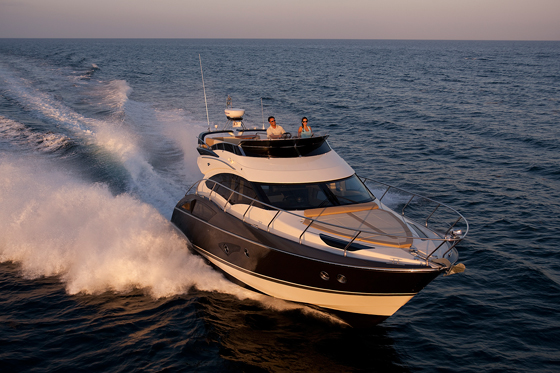
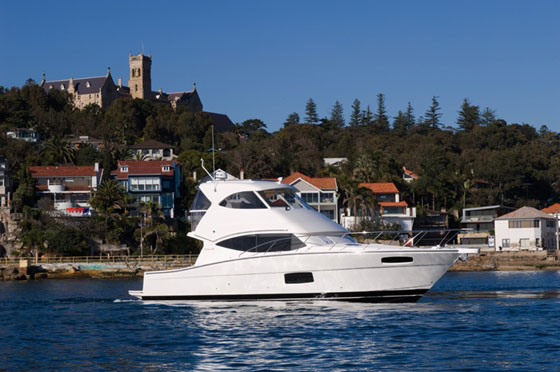
The Trojan 440 Express is an express-style boat in a sea of competitors.
The Trojan 440 Express is an express-style boat in a sea of competitors. While it is attractive at first glance, you really have to give the 440 Express an in-depth examination to see all that this boat has to offer.
Unique styling cues, such as a winged radar arch, give only a hint of the details that separate the 440 Express from the other sleek white boats lined up along the dock. Only after closer examination is it possible to see how much fun this boat can be.
It's What's Up Front That Counts
When you first approach the 440 Express, the first thing you'll notice is the lack of a bow pulpit.
In the 1980s, it seemed that every power boat larger than 18 feet had to have a bow pulpit with an anchor hanging off it. When coupled with a Danforth-style anchor, these pulpits had a habit of snagging pilings when windy conditions necessitated a less than smooth docking experience.
Pulpits also required spotlights to be placed on additional brackets to get them away from the anchor, or to be placed farther back on the vessel. That placement often resulted in light striking all the shiny stainless steel rails and reflecting back into the skipper's eyes.
Your night vision will be unaffected on the 440 Express, as the spotlight is mounted right on the deck, at the apex of the bow, letting you put light where you need it without reflection off the boat.
The anchor, in big-boat style, is mounted through a fitting in the bow, with the windlass mounted below hatches on the deck. This results in a clean profile forward — a popular styling trend with many builders. The anchor can be brought aboard without bringing mud onto the boat's deck, where it invariably dries to a hard, crusty, stinky mess.
Stout stainless steel rails rise from the deck to a good height, providing security for line handling. Large cleats are forward, one on each side, slightly abaft the bow. Two additional cleats on each side provide plenty of places for stringing lines and securing the boat when at the dock. Two more cleats, aft, are mounted on the curve of the transom, which should allow the stern to be tied close to the dock for ease of boarding without tripping over lines.
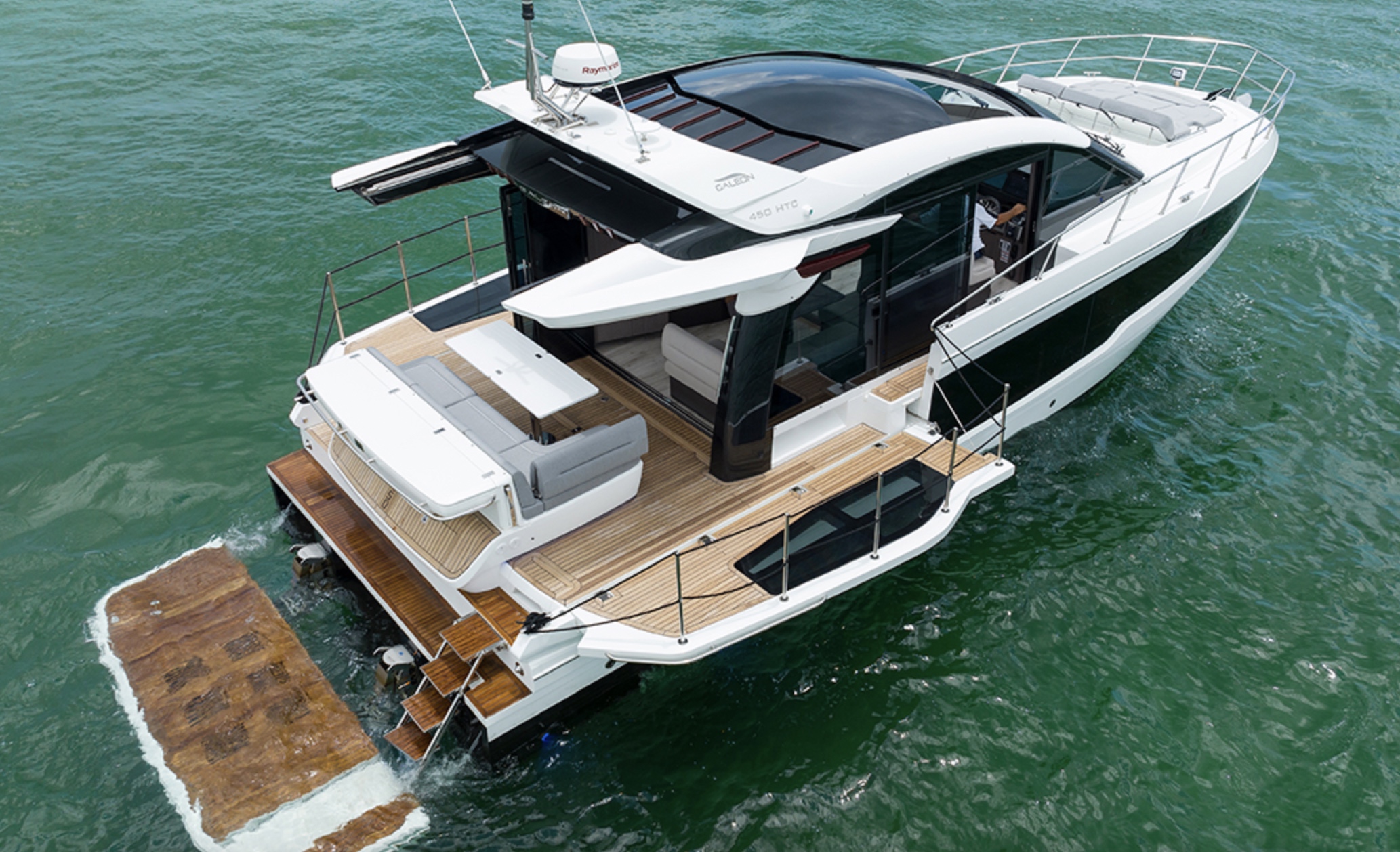
Working toward the boat's stern, past the large windshield, you'll see the boat's molded-in swim platform. Optional extended platforms are popular, and come in two styles: the traditional fixed platform and a hydraulically operated platform that lowers into the water for easy loading of personal watercraft.
With either the standard platform or the longer versions, the transom of the boat opens quicker than you can say "open sesame" — revealing a cavernous area that would be perfect for misbehaving children (don't call Child Welfare; I'm just kidding). Most owners will use this space for its intended purpose: storing personal watercraft. An optional swing-arm davit allows for easy loading of the toys.
Once the toys are put away in the toy box, you can step aboard through the starboard side transom door. You'll see a huge U-shaped lounge to port, with room for nearly a dozen friends.
On the starboard side, there's a refrigerator and an ice-maker, built into a wet bar that's larger than the galley in some small cruisers. The lounge (with storage for the necessities underneath) converts to a sunpad for lounging.
The helm is located up on the bridgedeck. A two-person bench/bucket helm seat is across from a matching double seat, to port. The windshield is stylish and attractive, but it seems a bit small when you're sitting at the helm. Skippers who stand at the wheel will be looking through isinglass panels in the canvas, or will be exposed to the wind stream above the glass.
The dash has plenty of room for electronics — much more than most boats of its size — arranged on a multi-tiered set of flat surfaces. The downside is that the control levers are a long reach for a seated skipper, and the angled planes of the dash point the faces of the navigational electronics too high. The compass is on the centerline of the dash, but the helm is about a foot to starboard, making running by compass headings somewhat difficult.
An optional hardtop is offered, with a sliding sunroof to keep weather out and let natural light in. Stylish in execution, the hardtop does reduce a skipper's view to just the windshield area, and the windshield posts are thicker to support the top.
A Look Inside
A sliding glass door provides entry to the cabin, where four steps lead to the saloon. The spacious saloon is dominated by a large curved settee, to starboard.
The sleek profile hides the nearly 7 feet of headroom here — and the cabin is larger than expected, considering the amount of cockpit outside. The boat's 15 foot beam helps add to the spaciousness, and makes room for an interior that's loaded with amenities, two heads and three staterooms.
The galley, to port, is large enough to provide for extensive meals (especially with the cockpit wet bar handling the cocktails and appetizers). However, like many new boats, it comes with a simple two-burner stove and a microwave oven.
While early models featured all-white laminate cabinetry, newer models have rich cherry wood, which provides a nice contrast to the soft off-white sides and headliner. A double-door refrigerator is standard — either a traditional stand-up style or a newer undercounter side-by-side. A television is positioned above the refrigerator, for easy viewing from the settee.
Forward, the master stateroom has a walk-around queen-size berth and a private en suite head with a stall shower. The large stall shower has a built-in seat and plenty of room to get ready for a night on the town, or clean up after a day on the beach.
The second head is abaft the galley and is accessible from either the saloon or the aft guest stateroom. This stateroom is one of two tucked under the bridgedeck, running the full width of the boat.
The portside stateroom is the largest, with a double berth, a hanging locker and a private entrance to the day head.
The starboard stateroom on early Trojan 440s was hidden behind a door that rolled to the side, allowing guests to crawl into a double bunk. Probably best-suited for children, this bunk became a full-fledged stateroom in newer models — with a standing-headroom changing area and a full-height door.
Power to Run
The real fun on this boat comes from what resides under a gas-assisted hatch in the cockpit floor. It, along with two additional hatches, provides engine room access.
A ladder leads down between big twin diesel powerplants, with good access to maintenance points. Most boats were delivered with twin 450 Cummins diesels (Volvo Penta 73Ps were optional), giving a cruise speed of around 27 mph. Top speeds over 31 mph (at 2,800 rpm) can be achieved, although probably when loaded closer to the boat's 30,000 pound wet weight.
On the whole, the 440 offers a tremendous amount of space, packed with features uncommon in vessels of this style, or this size range. Its attractive styling really makes it stand out among other express cruisers.
Next time you spot a Trojan 440 Express under way, take a look at the owners. The first thing you'll notice is that they're definitely having fun.
Trojan 440 Express Specifications
| Length | 44'7" |
| Beam | 15' |
| Draft | 4' |
| Weight | 30,000 pounds (loaded) |
| Fuel capacity | 432 gallons |
| Water capacity | 104 gallons |
| Standard power | twin 450C Cummins diesels |
Years of Production
1995-present
For More Information
Carver Yachts
P.O. Box 1010
Pulaski, WI 54162
www.carveryachts.com