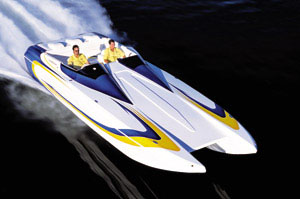
Eliminator 36 Daytona: Performance Test
Eliminator's 36 Daytona is one wicked cat.
December 11, 2001

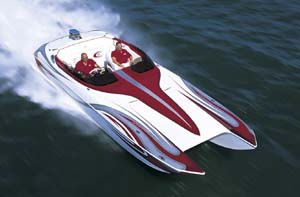
Top speed for the 36 Daytona was 114.9 mph. (All photos by Tom Newby)
We don't know—and really don't care—if cats have nine lives, but we do know this: Eliminator Boats offers nine cats with plenty of life. Of course, we're talking catamarans, the kind that pack air between the sponsons and reach speeds most V-bottom owners can only dream about.
At an honest 36' long, 8'10" wide, the 36 Daytona is the largest member of Eliminator's catamaran family. We're pleased to report that none of the superb performance and expert craftsmanship of the smaller models (from 19' to 33') were lost in the 36-footer, which was introduced in January 2000.
Base price for the 36 Daytona with a pair of MerCruiser 5.7-liter motors is $197,040, but frankly we can't imagine anyone ordering the boat with such a diminutive engine package. We suspect most buyers will order the boat with big power, such as the twin 620-hp Teague Custom Marine 509 mills that came in our test boat. That upgrade and others boosted the as-tested price to $309,654.
Performance

Twin custom-built 1,000-horsepower motors powered the 36 Daytona.
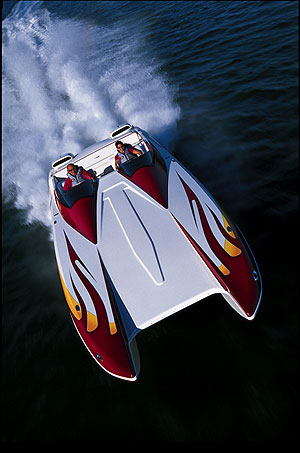
The 14-degree-transom-deadrise bottom of the catamaran had a small center pod, roughly 6 inches tall, with a sharp keel and two sponsons. Each sponson had two steps and a single strake that terminated about 2 feet from the transom, which was fitted with IMCO standoff-boxes and Xtreme drives spinning 15 1/4" x 34" four-blade stainless-steel cleaver propellers through a 1.36:1 reduction.
The marriage of a super-efficient, nearly full-tunnel bottom and 1,240 hp resulted in a top speed of 114.9 mph at 5,900 rpm in conditions that were a tad rough for wide-open running. Our lead test driver believed that in 1- to 2-foot chop, rather than the 3- to 4-footers we encountered during our tests, the 36 Daytona might well run to 118 mph. Better to "settle" for a tick below 115 mph than push it, he figured.
During one speed run at better than 100 mph, we crossed a tugboat wake, launched into the air and "four-pointed" the landing. The 36 Daytona settled back down immediately, which pleased our test driver and, frankly, relieved our less-experienced co-pilot.
"That was pretty impressive," said our test driver. "Another thing: At about 5,000 rpm you're doing around 102 mph, just cruising along in comfort. This cat will do that all day long."
Time to plane was a somewhat average 6.35 seconds, but once the 36 Daytona hooked up and came over, it took off. In 20 seconds, the catamaran reached 80 mph. The 8,100-pounder also packed solid midrange punch, running from 30 to 50 mph in 4.6 seconds, 40 to 60 mph in 5.9 seconds and 40 to 70 mph in 7.6 seconds.
Because the 36 Daytona's propellers rotated inward, the catamaran had a tendency to lean to the outside in low-speed turns. However, the cat earned better scores in slalom turns at 30 mph than at 40 mph. Those maneuvers were best at 50 mph, where the cat began to feel nimble. The boat did lean to the outside in circle turns at full and cruising speeds, but was within perfectly acceptable limits for a catamaran. Tracking at all speeds was straight and pure.
In water that our lead test driver described as "3- to 4-foot garbage," the 36 Daytona delivered a soft and quiet ride in head-on, quartering and following seas. That was particularly impressive given that it was running 70 mph with four people on board during an early evening photo session.
Workmanship
Mold work on the 36 Daytona was impeccable. Any flaws would have been easy to see in the catamaran's tall hullsides, and our inspectors found none. Gelcoat shine was brilliant, as was the execution of custom graphics. Of note, the manufacturer did a superb job bending the rubrail around the sharp corners, especially at the ends of the sponsons and at the transom.
Construction materials for the handlaid boat included vinylester resin and Knytex fiberglass. Baltek balsa was used for coring.
Rather than a fairing, the manufacturer outfitted the boat with acrylic half-canopies. Other hardware items included Eddie Marine billet bilge vent/grab-handle combos, various grab handles in the boat and an Eddie Marine swim platform.
Complete with Harwood-style scoops, the engine hatch raised on a single screw jack. The naturally aspirated big-block motors were secured on L-angles through-bolted to the stringers and Mercury Racing mounts. Nothing was left unattended in the engine compartment rigging. All wires were supported in stainless-steel cushion clamps. Batteries were mounted in billet boxes from Dana Products.
Interior
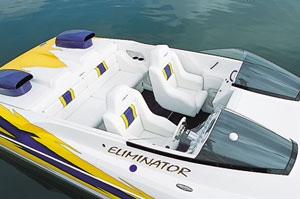
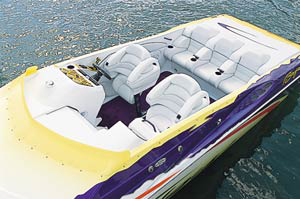
Quarter canopies kept the wind off the driver and copilot.
The cockpit was fitted with two bolsters (while the bottoms of the bolsters could be removed, the boat was designed for sit-down driving, hence the half-canopies) and a rear bench.
To port, the co-pilot had two grab handles from which to choose, one on the gunwale and another on the dash. Also at the co-pilot's dash was a glove box with an acrylic door.
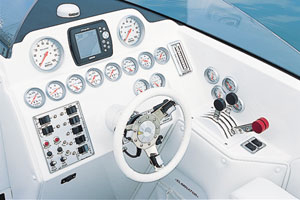
The helm station boasted a Garmin GPS unit flanked by two tachometers in pewter bezels.
The helm station had no speedometer. Rather, it boasted a Garmin GPS unit flanked by two tachometers in pewter bezels. Also in pewter bezels were other gauges grouped by engine. To the left of the steering wheel, which had a CRT trim control on the spokes, were most of the accessory switches. Bluewater mechanical indicators were provided to monitor drive trim. For throttles and shifters, the manufacturer went with products from Latham Marine.
Overall
Competition is hot and heavy in the 36'-long offshore catamaran category. No stranger to cats, Eliminator has a lively—make that roaring—contender on its hands in the 36 Daytona.
Test Results
Hull and Propulsion Information
| Deadrise at transom | 14 degrees |
| Centerline | 36' |
| Beam | 8'10" |
| Hull weight | 8,100 pounds |
| Engine (2) | Teague Custom Marine 509 |
| Cylinder type | V-8 |
| Cubic-inch displacement/horsepower | 509/620 |
| Lower-unit gear ratio | 1.36:1 |
| Propellers | Mercury 15 1/2" x 34" |
Pricing
| Base retail | $197,040 |
| Price as tested | $309,654 |
Standard Equipment
Twin 250-hp 5.7-liter V-8s with Alpha One drives, aluminum propellers, power steering, power tilt and trim, full instrumentation, ski-tow eye, billet gauge bezels, custom steering wheel with billet hub, 12-volt accessory plug, cleats, glove box, dual throttle levers, ice chest, dual batteries, electric hatch, cabin seats, berth pad, circuit-breaker panel, dome lights.
Options on Test Boat
Upgrade to twin Teague Custom Marine 620-hp 509 engines, ($66,000), stand-off boxes with full hydraulic steering ($17,000), IMCO Extreme drives ($11,539), custom sound system ($8,000), custom graphics ($4,000), lab-finished propellers ($1,800), Latham controls ($1,600), CRT steering wheel ($1,150), GPS ($775), Auto Meter gauges ($750).
Acceleration
| 5 seconds | 30 mph |
| 10 seconds | 50 mph |
| 15 seconds | 65 mph |
| 20 seconds | 80 mph |
Midrange Acceleration
| 30-50 mph | 4.6 seconds |
| 40-60 mph | 5.8 seconds |
| 40-70 mph | 7.6 seconds |
Rpm vs. Mph
| 1000 | 10 mph |
| 1500 | 12 mph |
| 2000 | 20 mph |
| 2500 | 37 mph |
| 3000 | 45 mph |
| 3500 | 64 mph |
| 4000 | 77 mph |
| 4500 | 94 mph |
| 5000 | 101 mph |
Top Speed
| Speedometer | 113.1 mph at 5300 rpm |
| Radar | 114.9 mph at 5300 rpm |
| Nordskog Performance Products GPS | 113.1 mph at 5300 rpm |
Planing
| Time to plane | 6.4 seconds |
| Minimum planing speed | 21 mph |
Fuel Economy
| At 45 mph | 1.6 mpg |
| At 55 mph | 1.7 mpg |
| At 65 mph | 1.7 mpg |
| At WOT | 1.6 mpg |
| Fuel capacity | 160 gallons |
Manufacturer
Eliminator Boats
Dept PB
10795 San Sevaine
Mira Loma, CA 91752
(909) 681-1222,
www.eliminatorboat.com.