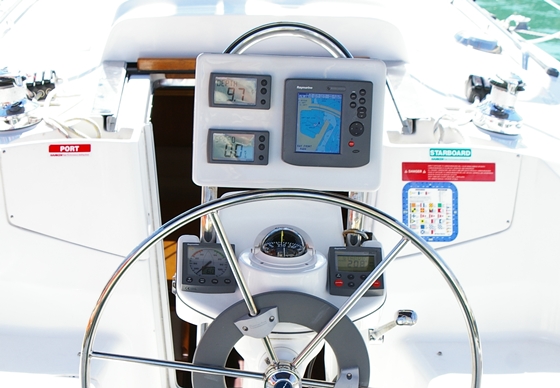
“Impact Resistant” Marine Electronics
Just how tough are these Delorme, Garmin, and Icom handhelds? We find out with fiberglass, rocks, and asphalt. Boom, baby!
You’ve seen the words “impact resistant” stamped on the box holding marine electronics gear many, many times. But, what exactly do these words mean? Are modern marine electronics able to take a fall, absorb abuse, and survive significant smashes? We wondered—so we decided to find out, first-hand. We invited every marine electronics manufacturer we could think of, 16 in all, to send us units to beat, batter, and eventually break. We’d see for ourselves just how resistant they were, and just how rough an impact they could take. But of those 16, only three companies were confident enough to take the challenge: DeLorme, Garmin, and Icom.
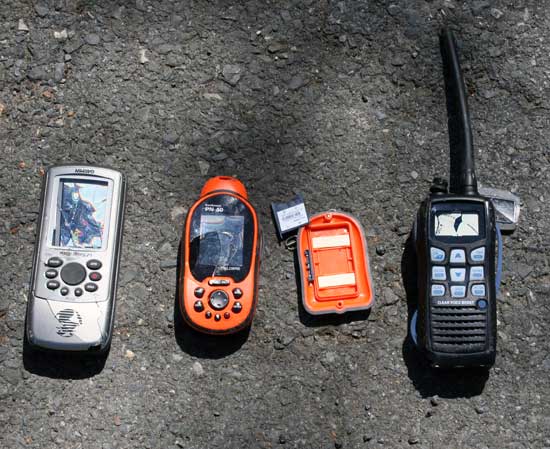
Our three crash test dummies, a little the worse for wear after several gravity tests.
Delorme Earthmate PN-40
DeLorme volunteered this WAAS-equipped 32-channel handheld GPS, which has an MSRP of around $400. Price varies depending on which mapping options you choose, but much of the available chartography is focused on land use, as opposed to marine use. Luckily, the unit’s chartography can be boosted by adding SDHC high-capacity SC cards up to 32 GB. DeLorme has traditionally built handheld GPS units targeting hikers, bikers, and other landlubbers, but the Earthmate can go either way. This multi-use attitude has become common among modern units, as more and more people find uses for handheld GPS on dry land. Yech.
My favorite thing about the Earthmate is the STMicroelectronics Cartesio chipset dual-core processor, which is hiding deep inside the casing. It’s quite powerful, and as a result the unit has instantaneous map and satellite imagery redraws, a 3-axis electronic compass, a barometric altimeter, and an accelerometer. The question is, just how tough is it?
Garmin GPSMAP 76Cx
Garmin tossed their GPSMAP 76Cx into the ring of electronic death. This unit lists at $349, but it’s advertised for closer to $275 on the web. Like the DeLorme it can read SD, and you can grow its brain by adding a 128-MB microSD card pre-loaded with MapSource data. Again, this also includes both land-based and on-water chartography, so it’ll come in handy whether you’re cruising or camping. The 76Cx has a 160 x 240 pixel 256 color LCD screen, is waterproof to IPX7 standards, and it also floats.
My favorite feature: The user interface is so darn simple to figure out, you’ll never crack open the instruction manual. Within seconds I was able to set and navigate to waypoints, zoom in and out, and change locations—IMHO, this is one of the easiest to use units on the market.
Icom IC-M36
Icom sent in our third contender, the IC-M36 handheld VHF radio. The M36, which MSRP’s for $310 but sells for around 30-percent less, has an unusual six watts of power; the vast majority of handheld VHFs have five. Another unique feature is its ability to automatically adjust audio levels of both transmission and reception, to compensate for ambient noise levels. That means a droning outboard or whipping wind doesn’t make communications impossible. Icom pulls off this nifty trick by integrating a sub-microphone on the radio’s rear, which inverts phase to cancel out ambient noises detected by the main mic. The unit is also IPX7 waterproof, floats, has dual/tri station watch, and comes with a rechargable li-Ion battery pack and charger.
My favorite feature is the noise compensation, for sure. But I wonder how good it is at compensating for the sound of a blunt instrument smacking into its faceplate… we’re going to find out.

Held high while standing on the gunwale of my boat, I let all three units fall 15 feet onto my stone driveway.
BOOM! BANG! BAM!
We figured we’d start the units out easy, with a realistic simulation of the shock every marine handheld on the face of the planet is sure to go through sooner or later: a fall to the deck. I lined the three contestants up on edge of the helm of my boat, nailed the throttles, and giggled as they slide off and tumbled to the deck. Unfortunately, none showed any signs of damage and all continued working. So I tried again. And again, and again. The DeLorme, Garmin, and Icom were unphased and unmarked—I’d have to try a little harder.
For the next impact on fiberglass, the units were held 10 feet aloft over the deck and sent into freefall. Boom! Bang! Bam! The clatter of raining nav gear was soothing to my soul, but after three drops, still, the units were unscathed.
It was time to get down and dirty—literally. We returned to the ramp, pulled the boat onto the trailer, and backed it into my stone driveway. Then I lined the units up on the gunwale and gave ‘em a little shove.
After three tries I inspected the units and found some minor-league scratches and chinks in their armor, but none were even moderately damaged. On the seventh try, however, I finally got some gratification. Falling repeatedly onto pointy rocks, it turns out, has more of an effect than falling onto fiberglass: after hearing an audible crunch I turned over the Garmin to discover two big cracks in its screen; it had landed face-down on a particularly pointy rock. Yippie!
Unfortunately, the unit was still fully functional. I’d have to kick it up another notch to kill it, and the others, dead. So I held ‘em high while standing on the gunwales, and then let ‘em fall from 15 feet.
Ten drops later, the units were looking a little rough. All had significant scuffs and scratches on the exterior, a third crack radiated across the Garmin’s screen, and the volume knob on the Icom broke. I pushed it back into place, however, and found that I could still adjust it without a problem. That meant the radio, along with both GPS units, remained functional and could continue the torture test.
I hadn’t expected these units to fare so well, so I was unprepared to measure the height of drops beyond 15 feet. Luckily, building codes dictate that power lines in Anne Arundel County are elevated 22 feet off the ground, and there was one spanning my driveway. What luck! All I had to do was toss the units as high as the power lines and we’d have a verified 20-plus foot fall.
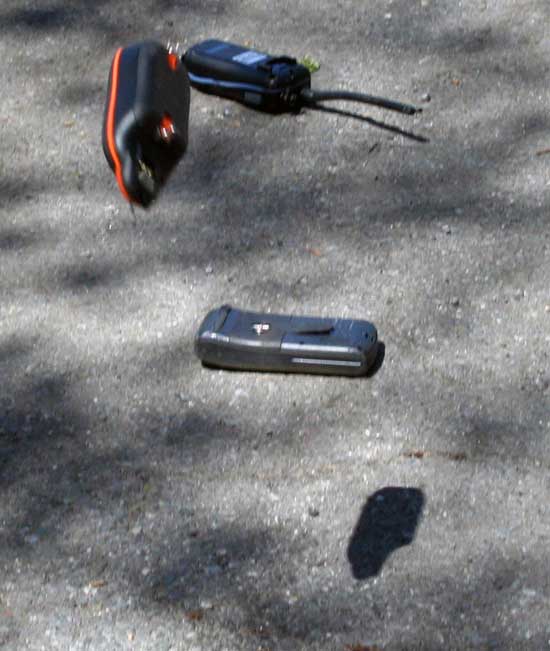
Boom! Bang! BAM!
With the enthusiasm you’d expect of any red-blooded American male who has a green light to smash expensive stuff, I let ‘em fly—and soon discovered the limit of “impact resistant.” Apparently, the claims don’t extend to multiple 20 foot flights that end with asphalt landings. On the third shot the Icom was knocked out of the race when the faceplate flew off the display, the gasket popped out of the casing, and the volume button broke off completely. Two tosses later the DeLorme, which still looked pretty good on the outside, went dark. And on the eighth landing the Garmin’s outer casing cracked open wide enough that I could see solder and wires—yet even with its guts exposed, the GPSMAP 76Cx was still completely functional.
Declaring the Garmin the winner, I set the units down next to each other to take photographs. And inexplicably, the DeLorme suddenly blinked back to life. Like a zombie after fresh brains, it just wouldn’t lay down and die. A closer inspection, however, showed that the battery case door had popped loose and the batteries had merely lost their contacts. A jiggle here and a push there, and the unit was back in the running again.
To break the tie we’d have to push the remaining two units even farther. I wound up, threw for the stars, and sent the Garmin on a flight I estimate to be about 35 feet in elevation. When gravity took over and the GPS kissed asphalt, it was game over—the Garmin was finally dead. Would the DeLorme survive, or would it meet the same fate? Alas, upon impact it too went blank—permanently.
So: what did we learn? First and foremost, smashing stuff up is fun, especially when it’s expensive stuff that you didn’t have to pay for. Secondly, when you read the words “impact resistant” on the side of a box containing a DeLorme handheld GPS, a Garmin handheld GPS, or an Icom handheld VHF radio, you can believe it. Unless you plan on pitching them over 20’ through the air where they’ll land on asphalt and rocks, these three units have the resistance to absorb the impact—and keep on working.
 Lenny Rudow has been a writer and editor in the marine field for over two decades and has authored five books. He runs his own web site at HookedOnFishingBoats.com and his syndicated blog appears at Boats.com in the BoaterMouth blog section.