Hybrid Electric Power: Will Your Next Boat Have it?
The technology is still evolving, but hybrid electric power may be a way to end your pain at the gas pump.
At boats.com we’ve been following new developments in gasoline-free outboard technology with a lot of interest. But when it comes to inboards, we're more skeptical about electric power. Range anxiety, cost, and the ability to re-charge while cruising are a few of the significant challenges. Besides, are people just too accustomed to planning around gallons per hour burned, and checking the fuel gauge?
But now there's a viable alternative to straight up electric: a hybrid.

There are entire fleets of recreational boats being built with hybrid electric power today, such as these Greenlines.
Replacing your current engine with a hybrid means adding an electric motor for primary propulsion, along with a companion diesel that can serve as a generator to charge the batteries, either for house use or to extend the boat’s range. With an appropriately sized generator, you can charge batteries and run propulsion at same time (assuming they aren’t overtaxed with house loads). Generators can also be set to auto-start in a low battery situation. Including the generator does mean additional complexity, space for a fuel tank, cooling, through hulls and rigging, but in the long run it makes a ton of sense.
You can repower your boat with a hybrid to replace a conventional diesel or gas engine such as an old Atomic 4 (also affectionately known as the Atomic bomb). Or, there are some interesting new models being built with hybrid engines such as the Hunter e36 or Seaway's Greenline yachts. Even Beneteau is getting into the hybrid business by outfitting its Swift Trawler 34 as a hybrid (see our feature Shock and Awesome: Beneteau Goes Hybrid With a Swift Tralwer 34).
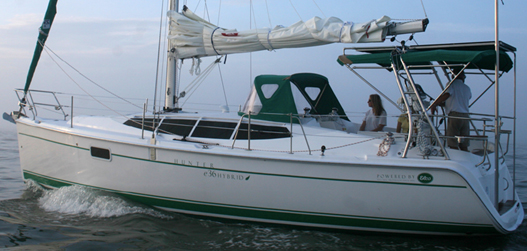
A Hunter e36 underway on electric power. Image courtesy of Marlow Hunter.
One manufacturer charting the route in this space, Elco, makes an AC, air-cooled, straight drive engine. A key advantage of AC engines is high efficiency and low maintenance. They can run up to 50,000 hours before any service is needed, when you have to replace the internal thrust bearings. The downside is they’re limited to 12-V systems, unless you also add an inverter. For the generator, they recommend installing one large enough to provide sufficient charging for continuous cruise.

The Elco electric hybrid engine comes with a companion generator for charging away from the dock and extended range. Image courtesy of Elco Motor Yacht.
From an economic point of view the electric hybrid is certainly appealing, with potential range and cost-per-mile dramatically less than those of a comparable diesel. Tested on a 36-foot sailboat with a hybrid engine and AGM (Absorbent Glass Mat) batteries, you see numbers that start to look very attractive compared to a 20 HP diesel. Obviously a number of factors including wind, tides, speed, propeller types, and battery sizes come into play, but the overall comparison is startling: a hybrid with 50 gallons of fuel for the generator can travel for 1,108 nautical miles at a cost of $0.07 per mile, while the diesel inboard can only make it 382 nautical miles on the same amount of fuel, for a cost per mile of $0.59.
Lithium Iron batteries are another option, made attractive by higher power density, lower weight, faster charging, and seven times the charging cycles. The downside is that they’re three times more expensive than traditional batteries. This makes them more suitable for racing, where weight is at a premium.
If you go with a purpose-built hybrid, such as the Greenline 33, lithium batteries may also come into play. But this builder has taken a different approach, with a parallel engine configuration. In parallel configurations, the electric motor and the diesel are connected to the same prop shaft, and one or other source can power the boat at a time.
According to Dan Krier at Marine Service Center, the Seattle dealer for Greenline, this boat can get over 12 miles under electric alone at four knots, extending up to 18 miles with the help of some solar charging. While this may not serve every cruisers’ needs, this drive mode would be very effective for short cruising, maneuvering in a marina, or motoring through long stretches of slow speed zones.

This Greenline hybrid layout shows the parallel drive configuration. A control system enables the driver to switch between electric and diesel. Image courtesy of Greenline.
Torqeedo, known for their electric outboards, is also taking steps into the inboard/hybrid segment with the Deep Blue Hybrid catamaran concept. One of their unique ideas is to add charging via a reverse propeller. By allowing the saildrive prop to rotate 180 degrees, it could be used as a hydro generator when the boat is under sail. This is an interesting concept, for sure, but after seeing the issues with hydro generators during the last Vendee Globe race—when several different boats encountered hydro generator problems that left them with partial or no power generation—I’d be worried about the potential risk of losing primary propulsion.
Is now the right time to go hybrid? If you’re in the market for a new boat or are looking to re-power, then it’s certainly worth considering—but expect to pay more. The motor can cost the same as a comparable diesel, but then you have to add the batteries. (Read Torqeedo Deep Blue Outboard and Hybrid: Electrifying Power for a comprehensive cost break-down).
In the long run, of course, the expense is like pre-paying for fuel. Plus, costs are decreasing as technology improves, and hybrid electric technology is evolving at a rapid pace. We’re hearing from the manufacturers that products in the next two to three years will get better and better, with more storage capacity and power than what’s out there on the market today.
New supercapacitor technology, for example, may bypass lithium batteries. Capacitors can hold an electrical charge, and although they aren’t batteries per se, supercapacitors are crossing the boundary into the battery’s space. They’re similar to lithium in terms of being able to take the abuse of many recharging cycles, but have 10 to 100 times the power density.
Imagine when fuel gauges are gone. We might not have to look too far in the future to see ourselves monitoring smartphone-like battery status displays, on boats wrapped in solar panels. And best of all— that could be life with no oil changes!
Looking for a hybrid boat? Here are some hybrid electric listings on boats.com.