Marine Technology 42 Victory Supercat: Performance Test
Marine Technology's 42' Victory Supercat makes a big splash with its honed and immaculate entry into the pleasure-boat market.
December 3, 2001

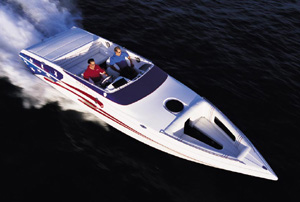
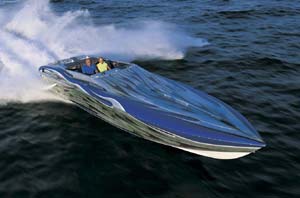
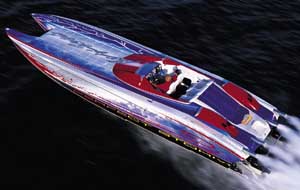
The 42' Victory Supercat rocketed to a top speed of 132 mph. (All photos by Tom Newby)
Talk about people's jaws dropping.
When Randy Scism himself accompanied the new Marine Technology 42' Victory Supercat to our Captiva Island, Fla., test facility, the passersby were floored—with good reason. Scism and the proud owner of the new 42' Victory, "Slug" Hefner, pulled into the marina of the South Seas Plantation, and crowds gathered to take a gander at Dirty Duck.
The $578,304 boat came to town with a host of custom features, most notably twin 900-hp blown and chilled Pontiac-headed 522 cubic-inch big blocks, dry-sump No. 6 drives, a $27,000 custom paint job and $20,000 worth of show-quality rigging. In stock form, the Victory costs $299,500 without power. Even in stock form, the 41'9"-boat is a lesson in custom features and hardware.
Performance
The tunnel of the boat was about 20 inches deep with no center sponson. To each side lay sponsons with inside lifting runners and four steps: two major, two minor. The first step was positioned about 20 feet forward of the transom. Each step was vented forward and broke the strakes and continued to the inside corner of the sponson. The last step was located about 12 feet from the end of the running surface. Aft of that step, water pickups fed the cooling needs of each engine and the intercoolers. At the trailing edge of the sponsons, MTI design engineers fitted Mercury 280S K-planes at the outermost edges, parallel with the bottom.
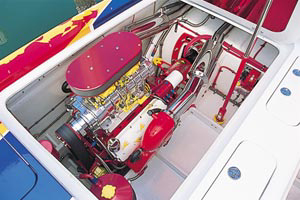
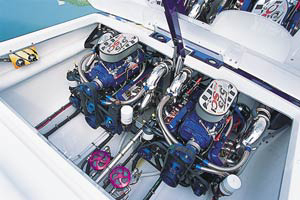
Engine compartment rigging was immaculate.
As equipped—with inward-rotating 16 1/4" x 35" five-blade propellers—the Victory ran 132 mph on the radar gun. It's important to note that during testing at Captiva Island, Fla., one of the engines broke multiple valve springs. Backfiring through the carburetor in protest, the boat still ran 106 mph in that condition. That shut down testing until the boat was repaired and a second set of tests could be performed at Mercury's Lake X test facility.
During those tests, one of the engines developed fuel-pressure problems. That said, the boat still cranked up to 5900 rpm and ran 132 mph on the radar gun. Where this boat began to shine was at about 4000 rpm, which had the boat moving along at 72 mph. Add another 1000 rpm and you get 105 mph. What is amazing is that the remaining 900 rpm netted another 27 mph.
Its handling also became better as speeds increased. For example, during slalom maneuvers at 30 mph, the boat leaned to the outside. But in turns at full throttle the boat leaned in and earned the highest marks possible from testers.
It was equally adept in heavy seas, which we were able to sample before the valve springs gave out. The Victory scored high points for handling quartering, following and head-on seas. It also tracked perfectly in the midrange and at top speeds. About the only negative aspect was that the steering pump would cavitate when the props left the water, which caused the steering wheel to twitch a bit.
Workmanship
When it comes to attention to detail and quality of construction and rigging, this boat was over the top. The logbooks were filled with nothing but praise for the paint job (for $27K it should be perfect), the gelcoat and the rubrail installation.
The lamination schedule consisted of composite construction, vacuum-bagged aircraft-grade balsa, S and E fiberglass cloth, and axial-stitched fiberglass fabric on the hull and deck, which were glassed together to create a unitized construction.
The two most outstanding aspects of the Victory's workmanship were the way it was wired and the meticulous nature of its rigging, which continued the "Dirty Duck" theme.
Under the electrically hoisted engine hatches, MTI provided a show-quality rigging job and an immaculate engine bay. Custom touches abounded. The brackets for the electric screw jacks were cut in the shape of duck feet. So were the brackets for the jack shaft scatter shields. All hoses that weren't steel-braided were sheathed in a color-matched red jacketing and supported with stainless-steel cushion clamps. Upon closer inspection, testers could see that MTI took apart all the clamps, polished them and the retaining screws, then reassembled them.
In addition, the head/changing room was fitted with a circuit-breaker panel. Inside, each wire was connected with sealed weather-pack connectors, numbered and identified by an index on the inside of the door.
Interior
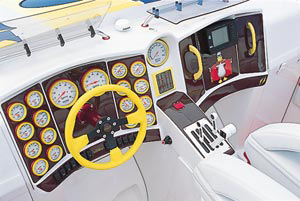
All gauges were in clear view at the helm, and the throttles and shifters were within easy reach.
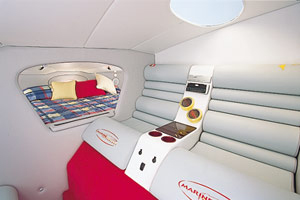
The 42' Victory's Supercat's cabin was uncommonly comfortable for that of a catamaran.
Immaculate is the best word to describe the Victory's interior and cockpit. Inside, the cabin featured a soft vinyl lounge that faced a bench seat along the hullside. There were cupholders, access to the stereo system and even a couple of compartments to keep bottles of wine chilled. Farther forward, the Victory was fitted with a king-size bed in a stateroom large enough to be comfortable for overnighting and weekends.
Out in the cockpit, the helm was fitted with full Gaffrig instrumentation, including a 160-mph liquid-filled speedometer, Gaffrig levers and incredible tinted carbon-fiber dash panels. To starboard, the navigator looked over a Garmin GPS Map 215.
Just behind the front bolsters, MTI included two rear-facing seats with molded-in stowage and coolers underneath. There were compartments that held three soft-side coolers, a blender and a sink. At the cockpit's rear, MTI built in a bench seat with room for four.
In short, there were many more details and features aboard the MTI than we have space to describe.
Overall
As soon as the 42' Victory Supercat pulled into the marina, crowds began to gather. It boasted the speed and performance of a race-bred machine and the features and amenities to rival a cabin cruiser. That's a tough combination to top.
Test Results
Hull and Propulsion Information
| Deadrise at transom | 19 degrees |
| Centerline | 41'9" |
| Beam | 10'6" |
| Hull weight | 10,500 pounds |
| Engines | Performance Automotive |
| Cylinder type | V-8 |
| Cubic-inch displacement/horsepower | 522/900 |
| Lower-unit gear ratio | 1.36:1 |
| Propellers | Mercury Racing 16 1/4" x 35" |
Pricing
| Base retail | $299,500 |
| Price as tested | $578,304 |
Standard Equipment
Vacuum-bagged core stringer and bulkheads, aircraft-grade balsa, multi-axial stitched fiberglass, hand layup, bonded hull and deck joint, Gaffrig instrumentation and levers, snap-in carpeting, fire extinguisher, head/changing room, flush-mount cleats, dual batteries, offshore battery mounts, hydraulic steering, fire extinguisher, steering wing plates and tie bar, transom air vent, Bravo trim actuator kit.
Options on Test Boat
Upgrade to 900-hp supercharged engines ($125,000), No. 6 dry-sump drives ($76,400), custom paint ($27,000), show-quality rigging ($20,000), Aeroquip hoses ($7,893), McLeod bolsters ($3,950), trim tabs ($3,300), vacuum-flush toilet ($2,600), GPS unit ($2,540), through-hull water pickups ($2,533), carbon-fiber trim package ($1,975), sea strainers ($1,650), pro-stock air scoops ($1,600), Monster gauge package ($915), stainless-steel lifting eyes ($633), ship to shore ($500), bezel package ($315).
Acceleration
| 5 seconds | 31 mph |
| 10 seconds | 44 mph |
| 15 seconds | 58 mph |
| 20 seconds | NA |
Midrange Acceleration
| 30-50 mph | 5.3 seconds |
| 40-60 mph | 5.8 seconds |
| 40-70 mph | 9.2 seconds |
Rpm vs. Mph
| 1000 | 9 mph |
| 1500 | 17 mph |
| 2000 | 29 mph |
| 2500 | 45 mph |
| 3000 | 50 mph |
| 3500 | 63 mph |
| 4000 | 72 mph |
| 4500 | 93 mph |
| 5000 | 105 mph |
Top Speed
| Speedometer | NA |
| Radar | 132 mph at 5900 rpm |
| Nordskog Performance Products GPS | 132 mph at 5900 rpm |
Planing
| Time to plane | 5.3 seconds |
| Minimum planing speed | 17 mph |
Fuel Economy
| At 45 mph | NA |
| At 55 mph | NA |
| At WOT | NA |
| Fuel capacity | 200 gallons |
Manufacturer
Marine Technology Inc.
Dept. PB.
2024 Waters Edge Court.
Lake St. Louis, MO 63367.
(314) 422-4428.
www.marinetechnologyinc.com.