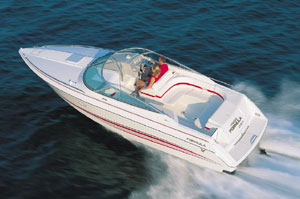
Carrera 280 Raptor: Performance Test
Carrera 280 Raptor blends aquatic hot-rod style and performance in a midcabin package.
May 12, 2002

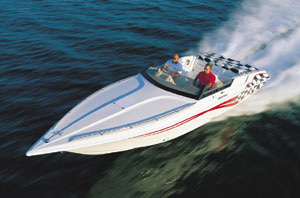
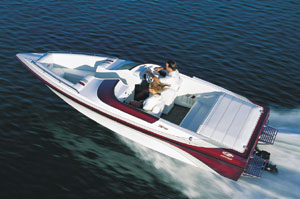
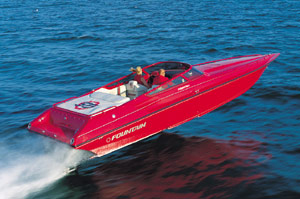
With the engine turning 5,200 rpm, the 280 Raptor ran a top speed of 67.1 mph. (Photos by Tom Newby)
What separates a "big" lake or river hot rod from a "small" offshore boat is mostly a matter of where the owner chooses—or dares—to run. Some big-lake boats should forever stay in tame inland waters, whereas other small offshore boats are overkill on anything but the wildest landlocked waterways. A few work well in both.
Put the Carrera 280 Raptor in that last category. We tested the 29'8"-long, 8'1"-wide midcabin offering in Long Beach, Calif., and it performed as well in the protected waters behind the breakwater as it did in the open sea in front of it.
Base price for the 280 Raptor with a MerCruiser 7.4-liter engine is $59,400. Our test boat came with several upgrades—key among them was a Mercury Racing HP500EFI engine—that raised the price to $86,650.
Performance
 The 470-hp HP500EFI remains one of Mercury Racing's strongest sellers, and it was an appropriate choice for our test boat. Coupled to the fuel-injected engine was a Bravo One XZ drive with a 1.5:1 ratio and, at the business end, a lab-finished Bravo One 15 1/4" x 24" four-blade stainless-steel propeller. For cooling the lower unit, the manufacturer included a Simrek drive shower.
With the engine turning 5,200 rpm, the 280 Raptor ran a top speed of 67.1 mph. Most impressive, however, were the 4,580-pounder's standing start and midrange acceleration numbers. It jumped on plane in 4.1 seconds and reached 63 mph in 20 seconds. The boat shot from 30 to 50 mph in 6 seconds and from 40 to 60 mph in 8.2 seconds.
In slalom turns at 30, 40 and 50 mph, the 280 Raptor transitioned smoothly with a nice inward lean and minimal outside roll between turns. Left and right circle turns at cruising speed were crisp—and crisper still at full speed.
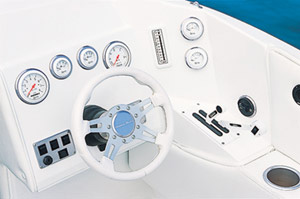
At the helm to starboard, the dash featured an array of Gaffrig gauges in gray bezels arranged around a tilt steering wheel.
Surely, the four-blade wheel helped the 280 Raptor stay hooked up, but most of the credit had to go the boat's 20-degree delta-pad bottom. The hull had four strakes—the outer pair running full length and the inner set terminating 10 feet forward of the transom—and 2-inch slightly negative chines.
In tracking tests, the boat maintained its heading at various speeds, even with abrupt changes in drive trim. Passenger weight shift didn't affect tracking. Wind, however, did have a noticeable effect—stronger gusts could push the boat slightly off course. That surprised us, given its low profile. When we did manage to find a few 1- to 2-footers outside the Long Beach breakwater, the 280 Raptor held its own and provided a generally smooth ride.
Workmanship
We did notice a few small waves in the 280 Raptor's mold work, but they didn't detract from the five-color gelcoat, which was vibrant, appealing and decidedly appropriate for the breed. To protect the boat's showy exterior, the manufacturer installed a plastic rubrail with stainless-steel flathead screws and took the time to neatly align all the screw heads.
The Carrera folks weren't exactly handing out details on the 280 Raptor's lamination ingredients. We were told, however, that the boat was handlaid with bidirectional and tridirectional fiberglass and vinylester resin. "High-tech" coring and an inner liner also were included in the construction recipe.
Dana Products provided the two hydraulic "scissor-lift" hinges for the engine hatch, which raised and lowered with the push of a rocker switch at the dash. Inside the engine compartment, the big-block motor was secured with Mercury Racing mounts on L-angles through-bolted to the stringers. Backing plates were used for extra brawn.

In addition to the well-designed bolsters, angled footrests were supplied for the driver and co-pilot.
Wiring in the engine compartment was as good as it gets. "It's so clean that it's almost nonexistent," said our lead inspector. "All the cables and wires enter the compartment just below the gunwale, so it almost appears that there's not enough rigging in the compartment to run the engine."
Interior
The length of the 280 Raptor afforded the manufacturer plenty of space to devote to the open bow. In fact, even our tallest inspector (6'4") found he could recline in comfort on either one of the two bow lounges.
The biggest surprise for the same inspector was the headroom in the midcabin, which had two facing lounges. He was able sit in the enclosed area without slouching.
The boat's greatest interior strength was its cockpit, which featured two bolsters with manual drop-outs that could be raised and lowered with one hand—without the driver or co-pilot having to look away from the water ahead. (If you've ever fumbled to drop a bolster bottom in rough water, you know that's important) In addition to the well-designed bolsters, angled footrests were supplied for the driver and co-pilot. Tunes for the entire boat were provided by a Sony Explode series stereo system with speakers from bow to stern.
At the helm to starboard, the dash featured an array of Gaffrig gauges in gray bezels arranged around a tilt steering wheel. Also included was a Bluewater mechanical drive-trim indicator. Mounted on the gunwale, the Gaffrig shifter and throttle included a trim switch on the throttle handle. Rocker switches for the accessories were set in an aluminum panel.
Overall
Call it a big midcabin lake boat. Call it a small midcabin offshore boat. By any name, the 280 Raptor is an exciting, well-built and versatile performer.
Test Results
Hull and Propulsion Information
| Deadrise at transom | 20 degrees |
| Centerline | 29'8" |
| Beam | 8'1" |
| Hull weight | 4,580 pounds |
| Engine | Mercury Racing HP500EFI |
| Cylinder type | V-8 |
| Cubic-inch displacement/horsepower | 502/470 |
| Lower-unit gear ratio | 1.5:1 |
| Propeller | Mercury Bravo One 15 1/4" x 24" |
Pricing
| Base retail | $59,400 |
| Price as tested | $86,650 |
Standard Equipment
Five-color gelcoat, four full-length stringers, 80-gallon fuel tank, custom marine interior with drop-out bolsters, marine carpet, full instrumentation with bezels, Gaffrig controls, courtesy lights, automatic bilge pump, stainless bow rails, dual batteries, Porta Potti, swim step, nav lights, direct and indirect cabin lights, ski stowage, rear boarding handles, Pop-Up? cleats, drink holders, ski-tow, deck hatch, cooler, four-speaker CD stereo,
Options on Test Boat
Upgrade to HP500EFI ($20,100), custom stereo ($3,500), hydraulic scissor hatch lift ($1,200), custom tail pipes ($1,200), custom paint ($1,000), upgraded Gaffrig gauges ($250).
Acceleration
| 5 seconds | 31 mph |
| 10 seconds | 49 mph |
| 15 seconds | 59 mph |
| 20 seconds | 63 mph |
Midrange Acceleration
| 30-50 mph | 6 seconds |
| 40-60 mph | 8.2 seconds |
| 40-70 mph | NA |
Rpm vs. Mph
| 1000 | 7 mph |
| 1500 | 9 mph |
| 2000 | 17 mph |
| 2500 | 28 mph |
| 3000 | 33 mph |
| 3500 | 41 mph |
| 4000 | 48 mph |
| 4500 | 58 mph |
| 5000 65 mph |
Top Speed
| Speedometer | 72 mph at 5200 rpm |
| Radar | 67.1 mph at 5200 rpm |
| Nordskog Performance Products GPS | 66.6 mph at 5200 rpm |
Planing
| Time to plane | 4.1 seconds |
| Minimum planing speed | 18.5 mph |
Fuel Economy
| At 45 mph | 2.2 mpg |
| At 55 mph | 1.9 mpg |
| At 55 mph | 1.6 mpg |
| At WOT | 1.6 mpg |
| Fuel capacity | 80 gallons |
Manufacturer
Carrera Boats
Dept. PB
1802 Pomona Road
Corona, CA 92880
(909) 735-7000
www.carreraboats.com.