Comet Pro-Star 20: Double Vision
Comet's Pro-Star 20 takes on shallow and rough
November 18, 2004

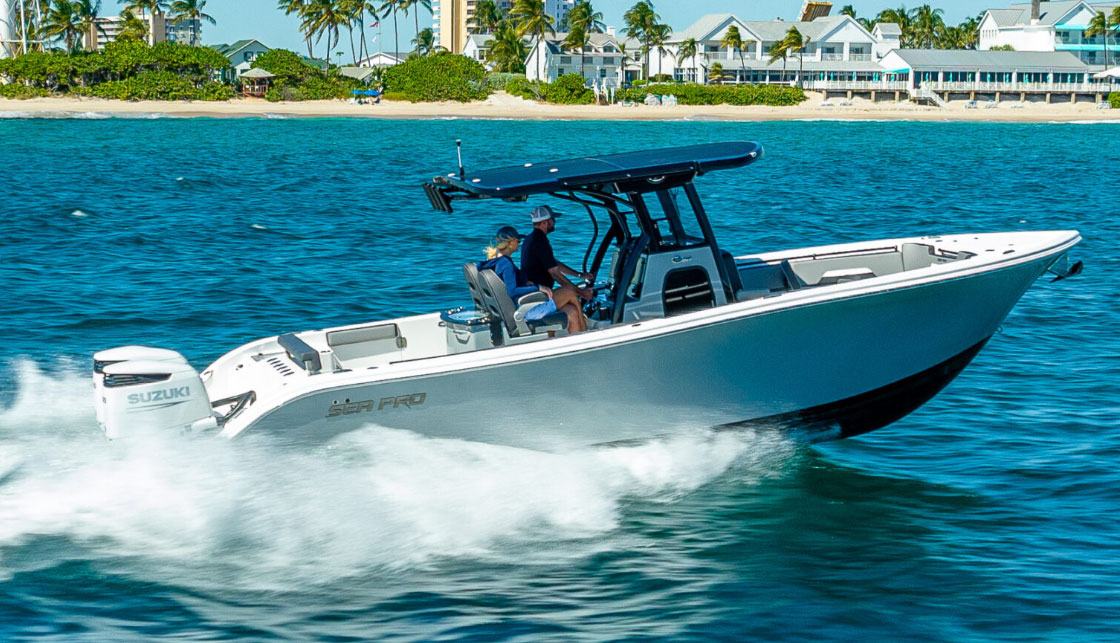
The Comet Pro-Star 20 features a catamaran hull with a single outboard.
Catamarans are becoming increasingly popular with coastal boaters thanks to their soft ride in rough water. But one slight drawback with most is that they're set up strictly for twin outboards. This not only costs more at the outset, but because the lower units must extend below the sponsons, it limits how shallow the hulls can run.
The Comet Pro-Star 20, on the other hand, is a single-engine cat designed to have the outboard mounted on a hydraulic jackplate. The boat can run in scant inches of water, yet still delivers impressive rough-water performance. It's a flats boat that you can comfortably take some distance offshore.
The Comet also delivers performance a notch above that of most catamarans, primarily because the sponsons have sharp, flat chines that provide lots of lift and make this a true planing boat.
Many cats have sharp hulls from bow to stern, making them semi-displacement boats. While they offer great rides, they just don't have the capability to really scoot because they sit too deep in the water.
On our test run on Florida's Tampa Bay, the Pro-Star cranked out 48.9 mph pushed by a Suzuki 225 EFI. Many cats of similar size pushed by the same power in twin outboards can barely crack 40.
The boat also displayed a remarkable hole-shot, averaging about 3 seconds from slow-idle. The bow seems to rise no more than 6 inches before the boat levels out and begins to plane. A big advantage of this on the flats is that the stern doesn't drop deep into the water, so you can get on top in shallow areas where other boats can't make the jump.
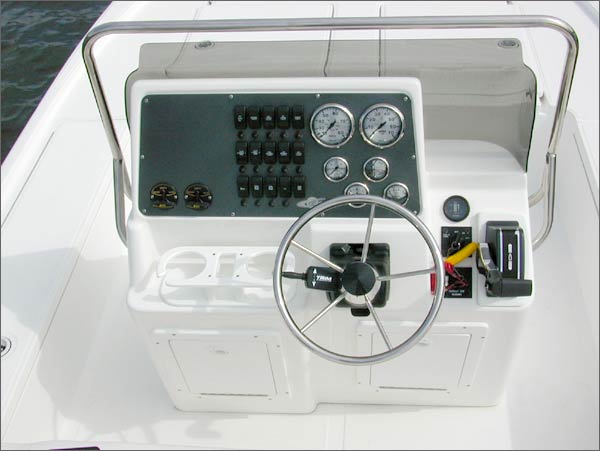
The Comet Pro-Star 20's console.
And once you're up and hit the jackplate control, the motor can be hoisted a full 6 inches off the transom. At that setting, the prop is running in the tunnel between the sponsons, and is not below the bottom of the boat at all. This allows the boat to cross areas less than a foot deep without damaging the prop and skeg or any seagrasses on bottom.
And, when we took the boat into rolling two-footers on the open bay, it was possible to remain comfortably seated at 4000 rpms and close to 40 mph. Most monohull flats and bay boats give a ride that's too rough for sitting when you run that fast in that sort of chop.
Handling in corners was typical of catamarans; the boat turns flat rather than leaning into the turn like a monohull. As a result you have the feeling that you're going to slide off the seat. Fortunately, the bench-type helm seat, wide enough for three, has arms on the ends to help hold you in place.
At speed, the trim doesn't affect the running attitude a great deal until about 4800 rpm, when you can feel the bow begin to lift and you get that "passing gear" feeling as the boat zips on up to top speed. (You have to go easy on the trim as soon as the bow lifts, otherwise the boat begins to porpoise.)
It wasn't easy to find anything to complain about on this boat, but I did notice that when running downwind in this same chop, the boat tended to "sneeze" or shoot droplets of spray out the front of the tunnel. These drops blow back onto the windshield and onto passengers seated on either side of the shield.
The sneezing is most pronounced at around 30 mph. Speed up a bit and it pretty much goes away. Many cats have a similar problem, and designer/president Jerry Semer said that an added pod in the forward tunnel reduces but does not totally eliminate sneeze on this hull.
This is a dry boat in terms of spray coming over the gunwales, however. Because the twin hulls have more freeboard than many monohull flats rigs, they help knock spray down.
Interior fiberglass work in the Comet is a match for the best on the market, with well-fitted hatches covering almost the entire front and back casting decks. Those casting decks are huge, by the way, totaling around 95 square feet. The front deck is considerably larger than that found on any conventional flats rig because it's squared off, rather than tapering forward as in a monohull.
For those into fishing live bait, or who want to enter catch-and-release flats or bass tournaments, the front livewell is a big plus. The well holds 50 gallons, more than you'll find even in the bait tanks of most big offshore sportfishing rigs. A Flow-Rite aeration system keeps fish alive in the wells all day long. (There's a second well holding 30 gallons aft, and that one alone is likely to be adequate for most live-baiters.)
Also impressive are the twin rod lockers under the gunwales. They include rod racks and are lighted. The gunwale doors have gas-assist, piston lifts to keep the doors open while you choose your weapon. The doors also have Perko locks for safe dockside storage. The lockers are 11 feet long, so they will store fully-rigged flyrods.
Other great storage areas are found inside the sponsons aft. In fact, these areas &!#8212; 28 inches deep, 33 inches wide and more than 8 feet long &!#8212; are big enough for you to get inside and hide from a passing storm. An optional portable head fits neatly into these areas, adding a facility that many families will find a rare treat on an open boat.
All hatches have deep gutters and foam gaskets to keep them dry and rattle-free. The hatch lids are foam "sandwiches," light but very stiff and strong. Below decks, four bulkheads or bridges hold the boat together, and the transom is a high-density foam that's as hard and strong as plywood, but which can never rot from water penetration.
For details, contact Comet Marine Corp., 1005 Marina Drive, Titusville, FL 32796; (321) 269-4200
Specifications
| Length: | 20'6" |
| Beam: | 8' |
| Fuel capacity: | 66 gals. |
| Weight: | 1,750 lbs. |
| Max HP: | 250 |
| Draft with motor down: | 12" |
| Price with Suzuki 225: | $35,000 |