Beneteau Sense 50: It Just Makes Sense
This new 50 footer incorporates so many innovations, it might even re-energize the sailboat market.
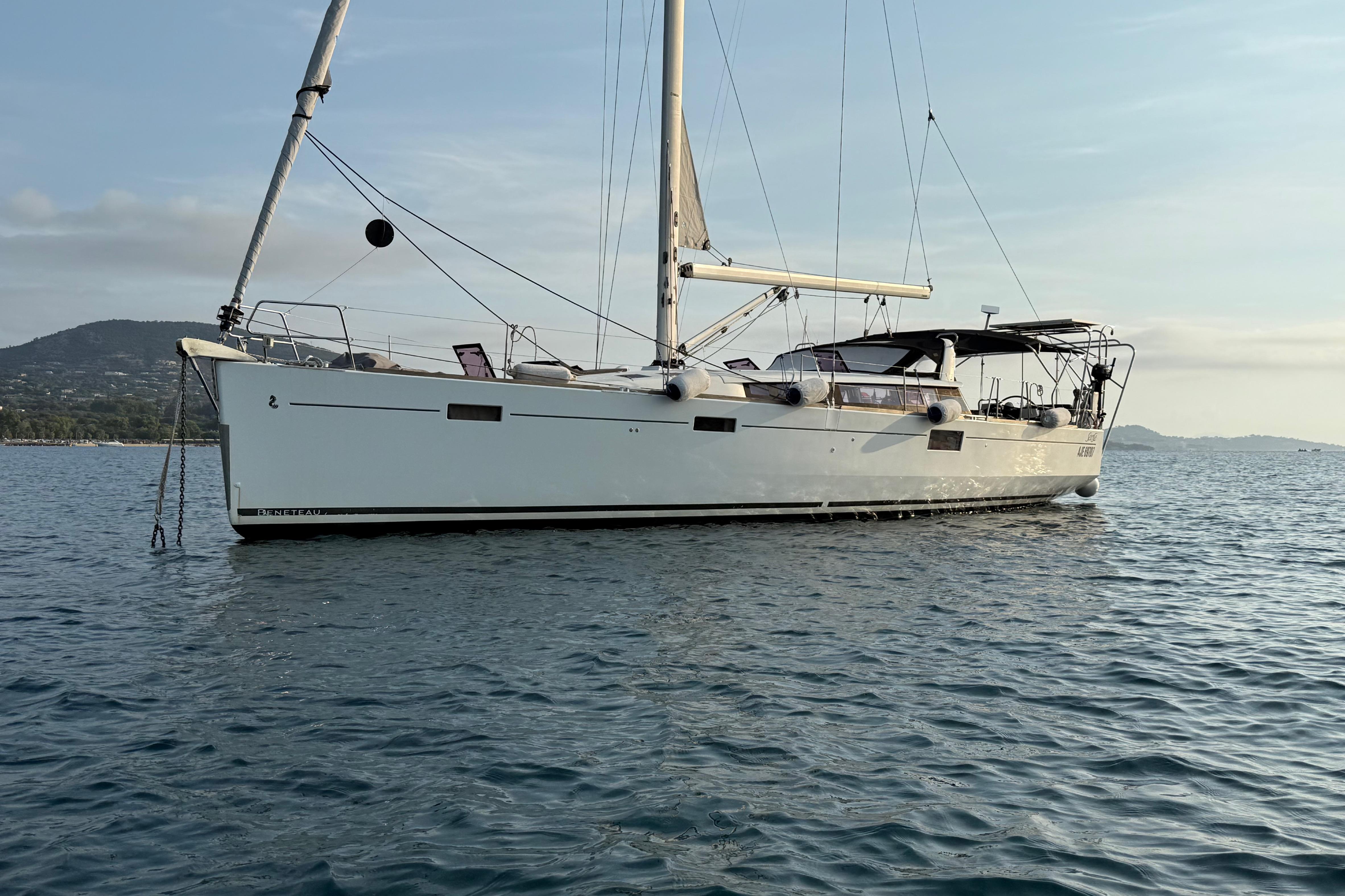
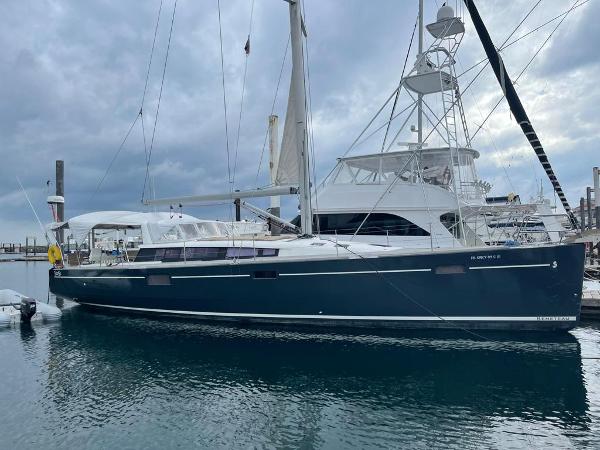
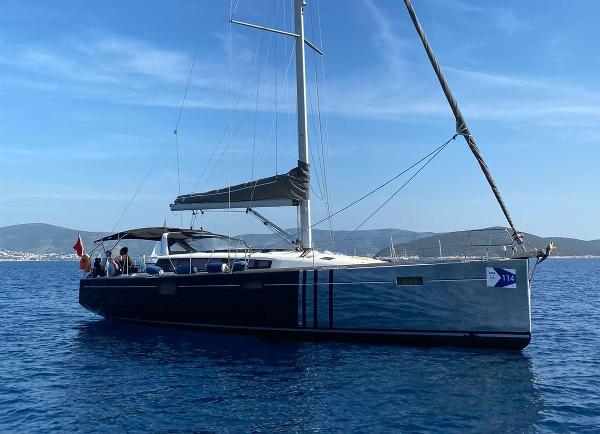
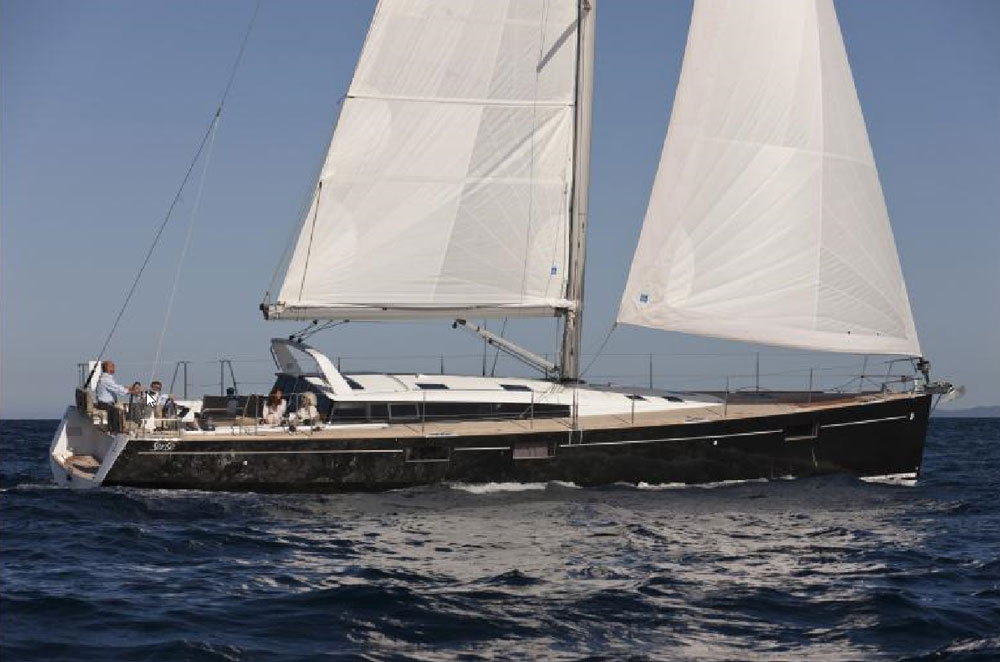
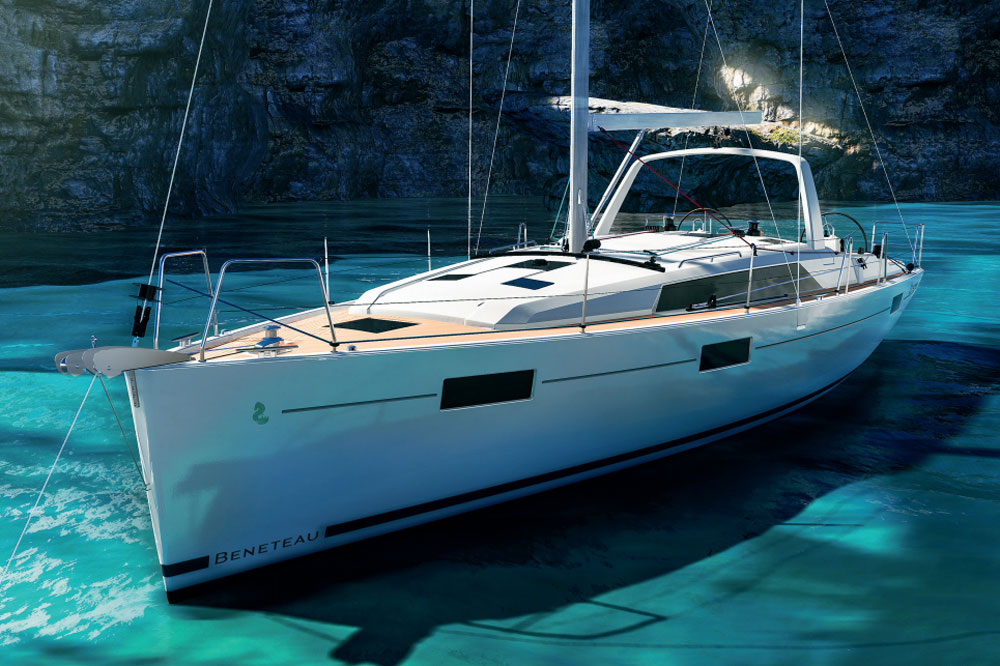
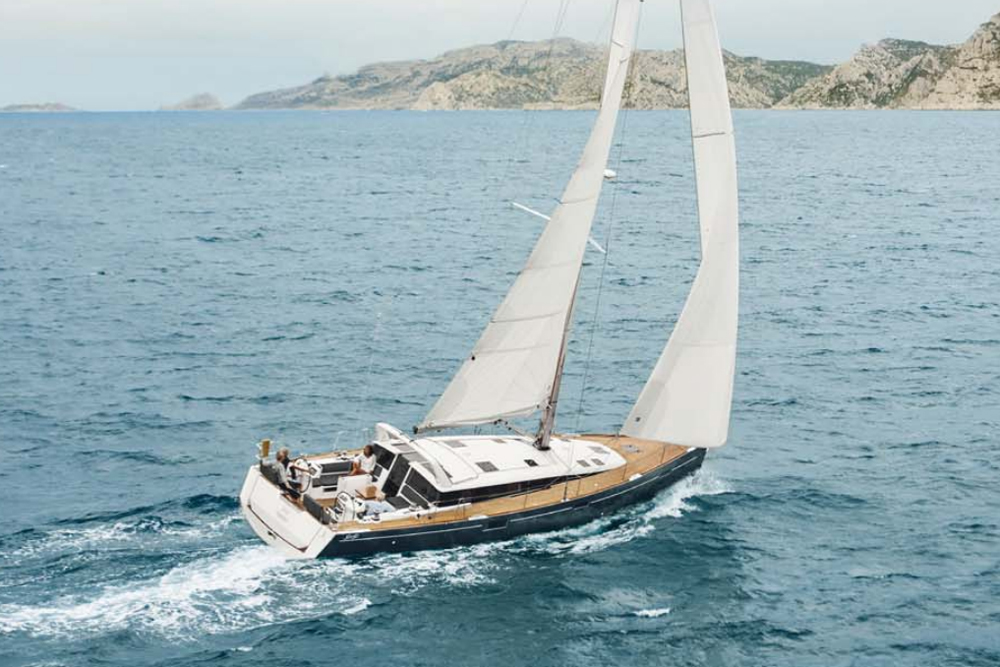
There are few boats that truly earn the title of ‘show stopper,’ but this year in Annapolis the Beneteau Sense 50 did exactly that. At noon, 2pm and 6pm, Beneteau untied the docklines and spun the 50 footer in its own length under its own power, often against a 20 knot cross breeze. That caught the attention of the eager crowds lining the docks and got them to come aboard. This boat was designed from scratch with innovative ideas that, you guessed it, just make sense.
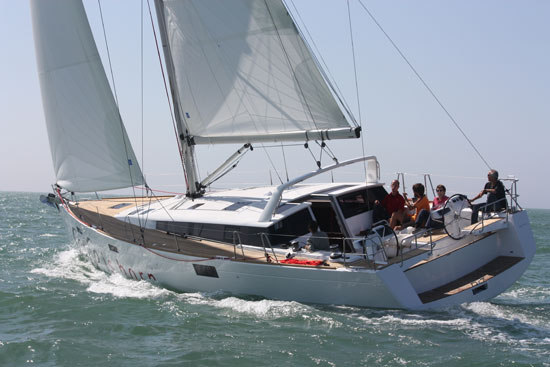
The decks are wide and clear, and all control lines are led aft inside a tunnel.
The boat’s maneuverability comes from Beneteau’s Dock and Go steering system. It features a joystick control that synchronizes a 360 degree pivoting propeller with a bowthruster to move the boat forward, aft, or completely sideways. As the boat spins, the Yanmar 75HP sail drive coordinates with the bowthruster while the Raymarine autopilot manages the rudder. This is very much like what Volvo did with their IPS system for powerboats, and the result is total control with a lot less anxiety—especially when docking.
Cockpit & Deck
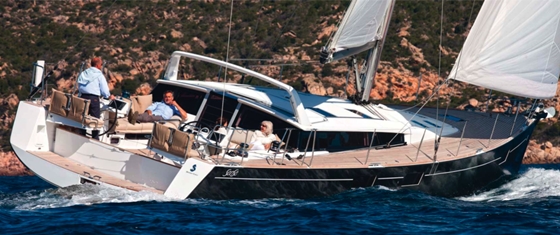
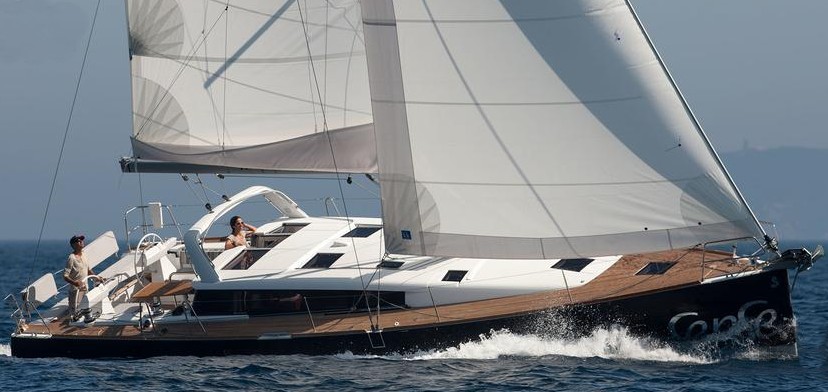
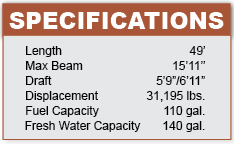
And easy boat handling is just the beginning. It seems the yacht design group of Berret-Racoupeau tossed out any preconceived notions of what a cruising monohull should be and started fresh, somehow succeeding in creating a look that’s both imposing and inviting. It’s a massive platform with a 49’ LOA and 15’ 11” on the beam that is carried well aft. This width is what allowed the construction of an almost catamaran-like cockpit, with an easy entry off a broad swim platform and one step up to the twin wheels. Visibility forward from the helm stations is excellent, and there is plenty of room for sailing instruments on one side and a plotter on the other. The joystick is on the starboard side only.
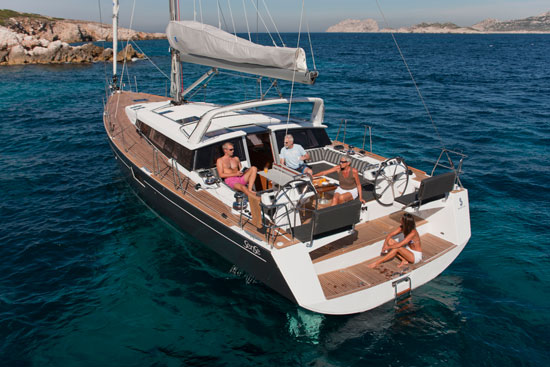
The almost catamaran-like cockpit has a broad swim platform.
The seats behind each helm station lift up and out to open the entire transom, creating an inviting terrace with a U-shaped settee to starboard and a table that can be folded and lowered to a cocktail table or made into a sun pad or bed for two. On the port side, a straight bench lifts to reveal a large storage space (or an optional bunk for either adventurous children or unruly crew).
Two electric primary winches are within easy reach of the wheels while farther forward, but also on the cockpit coaming, are two more winches with rope clutches to control the rest of the lines and halyards. Built-in sheet boxes provide line storage, though it might get a bit messy given the number of lines. The arch over the companionway secures the mainsheet, allowing for efficient end-boom sheeting. When integrated with a small white dodger forward, the arch is hardly noticeable and blends nicely into the lines of the boat.
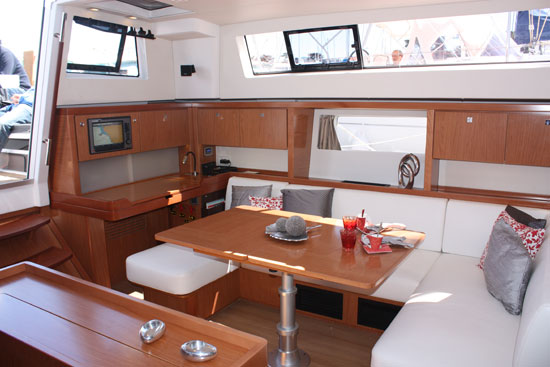
A U-shaped settee forms the seat to the aft-facing nav station.
The cockpit sole lifts up to access all the machinery. This was done by design to keep all the noise-making equipment well away from the living areas, and the space is accessed via a ladder—there’s even room for a washing machine.
Instead of hatch boards, an optional electric lift adjust the companionway door to any level, so the “doorway” can be as open or closed as conditions dictate.
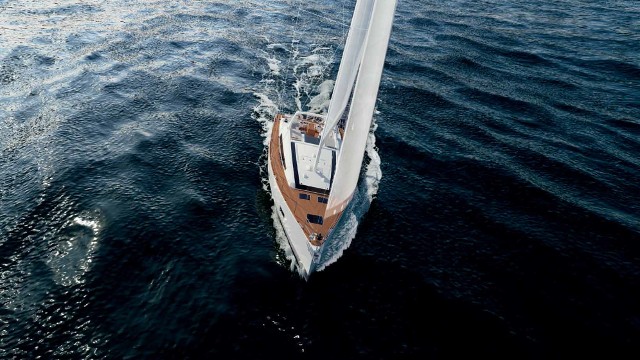
The decks are wide and clear, with 15 flush hatches and a nice deep anchor locker forward that will allow for a straight fall of the chain from the electric windlass. All control lines are led aft to the cockpit via a tunnel which eliminates clutter and tripping hazards, and the bow, stern and midship cleats are stout and tall to accommodate thick docklines.
Accommodations
Life aboard the Sense 50 is divided into three areas – the easy outdoor living of the cockpit, the centralized social space of the saloon/galley and the quiet cabins forward. Three easy steps, angled at 45 degrees, lead down to the living area where interior design firm Nauta Design was clearly up to the task of continuing the innovative ideas and ergonomics. Sleek, angular and very Euro-chic, the “greatroom” living space is finished in alpi fruitwood with an oak laminated cabin sole. It feels very rich and comfortable.
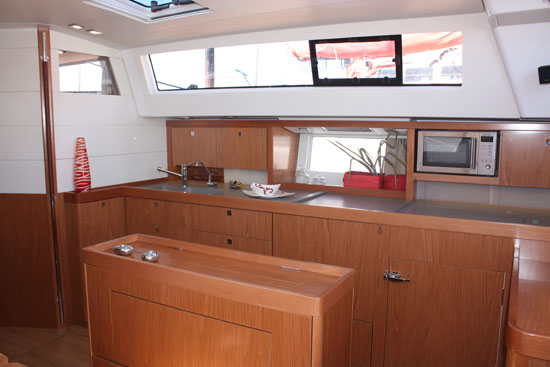
The straight-line galley runs up the starboard side.
The straight-line galley runs up the starboard side and has great storage. Everything is built so it doesn’t interrupt the clean lines – even the stove has a slide-away door and countertop to hide when not in use. A pass-through cut-out is built into the aft port for direct communication between the galley and the cockpit.
A pop-up flat screen TV faces the saloon.
To port is a U-shaped settee that forms the seat to the sizeable aft-facing nav station, while also wrapping around a table that will seat 6-8 for dinner or drinks. The entire space is interrupted only by a center island, which serves as extra counter space but also hides a folding seat and a pop-up flat screen TV. Both face the saloon.
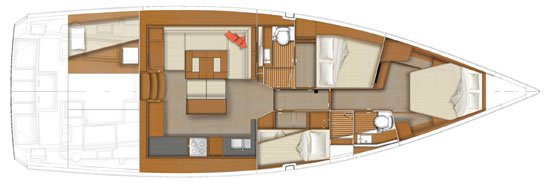
The Sense 50 is available in two or three cabin layouts. The master stateroom is forward with an island queen berth, a small vanity desk and a large, ensuite head with a stall shower. Two non-opening hull ports and a hatch overhead provide good light. Aft to port is a guest cabin with a double berth, and a second head with a separate stall shower. To starboard is a cabin that has either over/under bunks or can be made into a roomy office with a large desk and lots of cabinet space.
Performance & Options
The Sense 50 hasn’t been broadly available for test sails yet, but everything about the design suggests it will be fast but still manageable. It is designed to deliver maximum performance at 15 degrees of heel, rather than the normal 20 degrees. From the sleek light displacement hull (31,195 lbs.) and low coachroof with angular windows, to the slippery underbody with a spade rudder and choice of keel drafts (6’ 11” or a bulb with 5’ 10”), this boat is almost more like an ocean racing Open 50 than a traditional cruiser. The double spreader rig supports 1313 square feet of sail area, 678 feet of which is in the mainsail, so good speed is expected.
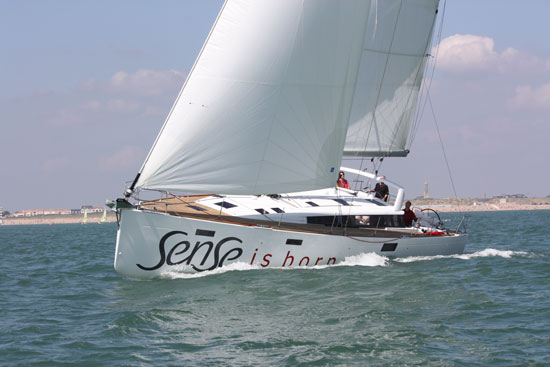
Everything about the Sense 50 suggests it will be fast but still manageable.
The base price of the Sense 50 is $398,000 but with all the upgrades available, sailaway can be more like $560,000. The options list is long and includes many items like a recharging station, multiple flat panel TVs, electric tables and blinds and upgraded tankage (from 110 gallons of fuel to 220, and from 140 gallons of fresh water to 190).
For those who want a new kind of sailing experience but in a smaller package, Beneteau has a similar 42 footer in the works with two cabins and one head. The Sense 50 is a game-changer for so many reasons, and a real argument for tossing out old ideas and starting with a blank sheet of paper. It will undoubtedly revolutionize yacht design inside and out, and possibly even re-energize a sluggish sailboat market.
 Zuzana Prochazka is a U.S. Coast Guard Master with 20 years of boating experience. She is technical editor for Latitudes & Attitudes and a regular contributor to MadMariner. Her work also has appeared in Santana (where she previously was editor) and the Sunday magazine of the Los Angeles Times.