Sundowner Tug 30
Contact Seller
XPresented For Sale By:
Florida Coast Yachts
United States
| Make | Sundowner Tug |
|---|---|
| Model | 30 |
| Year | 1988 |
| Condition | Used |
| Price | US$55,000 |
| Type | Power |
| Class | Tug |
| Length | 30 ft |
| Fuel Type | Diesel |
| Hull Material | Fiberglass |
| Location | Fort Pierce, Florida |
| LOA | 30 ft |
|---|---|
| Beam | 11 ft 4 in |
| Max Draft | 3 ft 9 in |
| Displacement | 13500 lb |
| Engine Type | Inboard |
|---|---|
| Engine Make | Ford Lehman |
| Fuel Type | Diesel |
| Power | 90 hp |
| Drive Type | Direct Drive |
| Engine Location | enums.engine-location.center |
| Propeller Type | 3 Blade |
| Propeller Material | Bronze |
| Engine usage (hours) | 7400 |
| Covers |
|
|---|---|
| Electrical Equipment |
|
| Electronics |
|
| Inside Equipment |
|
| Outside Equipment/Extras |
|
| Designer | Jack Sarin N.A. |
|---|---|
| Builder | Chausson FRP Boatworks, Taiwan |
| Fuel Tanks | 2 x 65 gal |
| Fresh Water Tanks | 120 gal |
| Hull Shape | Monohull |
| Windlass | Electric Windlass |
Description
REDUCED $55,000.00 REDUCED
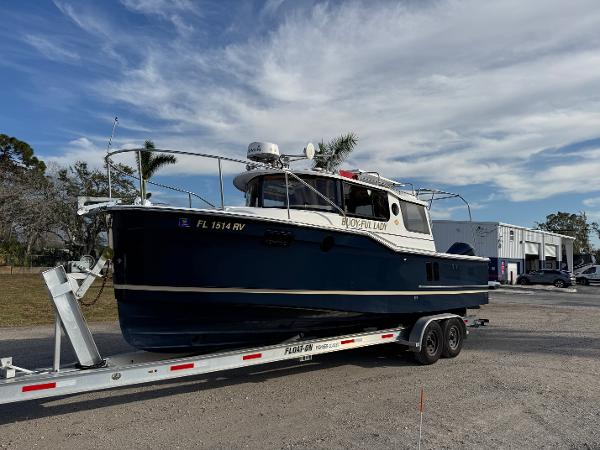
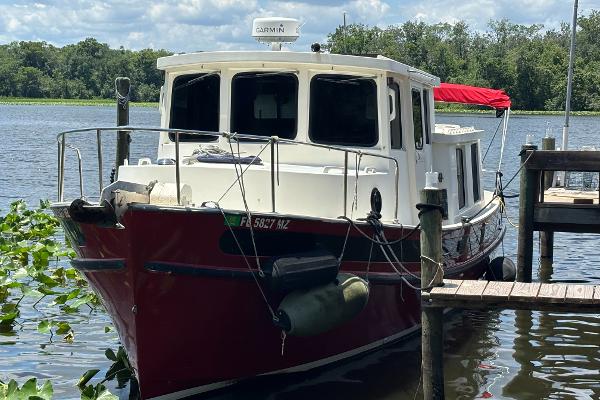
Introducing Manana, the Sundowner Tug 30, a remarkable vessel from 1988 that showcases the perfect blend of functionality and charm. With an overall length of 30 feet, this used tugboat is crafted from durable fiberglass, ensuring longevity and resilience on the water. Powered by a reliable Lehman diesel engine, delivering 90 horse power, it features a direct drive configuration with a Borg Warner Velvet drive 2.1 reduction, Wagner 700 hydraulic single station steering with SITEX autopilot and 12V pump for smooth navigation. Dometic AC, two (2) 65 gallon aluminum fuel tanks. Four (4) solar panels total 200W, Diesel Fisher-Panda 5KW generator with 700 hrs. The electric windlass enhances convenience, making anchoring effortless, along with the Ultra Marine SS Anchor with flip swivel, a curved lead filled tip for instant penetration for maximum holding power. The Manana is designed for those who appreciate the efficiency of a classic tugboat, offering a sturdy and dependable platform for various maritime adventures. Whether you're cruising along the coast or navigating the Loop, this vessel promises a reliable and enjoyable experience. Embrace the spirit of the sea with the Sundowner Tug 30, a true testament to quality craftsmanship and timeless design.
Additional Information
Boat is fully equipped with galley accessories, maintenance tools, ample list of spare parts, two extra aluminum Fortress anchors, one spare bronze propeller, many additional deck lines, a Fold-a-boat dingy with electric trolling motor, a Sea Eagle inflatable kayak, and two CO2 Mustang inflatable PFDs. List of spare parts (totaling more than $ 5K) available upon request.
- Diesel fuel capacity is 130 gals, two 65 gal tanks
- Main propulsion Borg Warner Velvet drive 2.1 reduction
- Wagner 700 hydraulic single station steering with SITEX autopilot and 12V pump.
- Water tanks total 120 gal
- 120VAC system with SHORE/GEN transfer switch:
- Diesel Fisher-Panda 5kW generator with 700 hrs
- Dometic air conditioner
- 0.7 cubic feet, 700W microwave oven
- Galley Maid 2-burner range
- 400W 12VDC / 120VAC inverter
12VDC system:
- 4 LiPO4 100AH batteries (new April 2025)
- 4 solar panels total 200W
- 12VDC / 120 VAC refrigerator (new 2024)
The Company offers the details of this vessel in good faith but cannot guarantee or warrant the accuracy of this information nor warrant the condition of the vessel. A buyer should instruct his agents, or his surveyors, to investigate such details as the buyer desires validated. This vessel is offered subject to prior sale, price change, or withdrawal without notice.
SELER'S COMMENT
DESCRIPTION OF SYSTEMS ABOARD MANANA
These descriptions should offer an introduction to the boat’s operation. Its purpose is that a new owner can understand and look-up the technical aspects of the systems belonging to the boat. That will help in maintenance and troubleshooting.
- THE BOW
It basically has a V-berth but an additional cushion and its associated platform has been added so that the starboard side becomes the equivalent of a double bed. The berth contains a 12VDC dehumidifier that can be left running when at the dock and with the cabin doors closed. There are two 12V reading lights and two 12V circulating fans. The volume below the bunk offers good storage for supplies that do not need quick access. Since the boat is a displacement hull, heavy objects should be stored near the bow to offset the weight of fuel and potable water located in the aft sections. Some spare parts are stored here, like pumps, heat-exchangers, a bronze propeller, lubricants, chemicals, cases of beverages and such. The volume under the berth is accessible through three small doors near the floor, facilitating access for the smaller items.
Against the bow is the control relay for the operation of the 12-volt reversing winch for the ground tackle located above deck. The control receives up-down signals from two stations: from the pilot house and from the foot-switches near the winch itself. High-current supply cables run back to the house battery bank, first leading to a circuit breaker located on the aft-bulkhead inside the hanging-clothes locker.
Above the bunk and against the bow is a rope locker with a single-access door. The center compartment holds the main stainless steel 15-foot anchor chain with its 150-foot braided rode. To each side are additional rope lockers that hold each a 150-foot braided rode and these are accessible from deck fittings on the fore deck. All three lines have their ends locked to the boat so that they can be let out completely without fear of loss.
- THE PORT LOCKER
It is meant mainly for clothes storage. On top of its left wall it has the breaker for the anchor winch and below that is the access to the backside of the main electrical breaker panel. Once open, at the top is the 120VAC section and lower down is the 12VDC section. There is a 12V light for convenience. The 400W inverter and its switch-over timed relay are also located there. Below the bottom panel there is a very convenient storage area for smaller spare parts.
- THE HEAD
The sink supplies cold and hot potable water from the fresh water automatic pump. A hand-held shower head is incorporated. The sink’s drain goes straight overboard. The pan below the floor grate drains into the bilges. The macerating toilet, operated by a manual push-button, draws external water for flushing but should be assisted with manual squirting of fresh water from a plastic bottle. An odor-controlling chemical should be added to each flush. The waste will flow into a 27-gallon holding tank located on the starboard side under the galley. The breaker for the macerating toilet is located on the forward-side of the box holding batteries No. 1 and No. 2 below the pilot house floor.
- THE PILOT HOUSE
The steering is a single-station hydraulic system. The mechanical reciprocating pump is behind the wheel and is visually accessible from the head by removing the panel screws of the box above the sink for cleanup and maintenance. The liquid reservoir is accessible by lifting the pilot instrument control panel and carefully removing its clear-top cap. Proper level of ATF (Automatic Transmission Fluid) should be maintained for reliable steering. Should the level become too low, any entrained air can be pumped out as visible bubbles on the reservoir surface by rocking the wheel in small back-and-forth rotations. The system has leaks and the captain has to periodically maintain an acceptable steering liquid level.
The control panel has these instruments: digital depth sounder (in feet, boat hits bottom at indicated 2.9, real 3.9), battery voltage, engine temperature, oil pressure and motor RPM. An alarm will sound with low oil pressure or high coolant temperature, this later one having two separate parallel detecting devices for redundancy. A switch under the lift-up instrument panel can silence the alarm, to be used at the captain’s discretion. The navigation light switch will activate on its first indent the standard green-red lights plus the top anchor light and the white stern light. On the second indent only the top anchor light will be on plus the digital depth indicator.
Special note: the engine key switch must be in the RUN position in order for the STOP momentary switch to activate the shutdown solenoid.
Electronic devices are self-explanatory. One HOOK GPS (with depth sounder) and a Garmin GPS display will track your progress. The SITEX autopilot can be activated by either of its two hand-held control stations when plugged in to the outlet on the right side of the steering wheel. An extension cord is available under the sliding pilot’s seat to allow steering from above the pilot house or on the fore-deck. However, speed still has to be managed from the pilot house manual lever.
Above the pilot station is the searchlight control. A switch will turn the spot beam on and right-left movements of the toggle switch will make it rotate. When the cord is pulled down, the light will turn off, a convenient and quick feature. A standard VHF radio with its top-side antenna will allow common marine communications, generally useful when approaching bridges or marinas. To the far left there is a Carbon-Monoxide detector that is battery-powered. It will beep if the battery is low and will wake you up if there is any danger of CO2 poisoning.
Not easily visible and located inside the port side storage locker behind the foot-box and towards the front, there is the magnetic flux sensor for the Sitex autopilot. Avoid placing magnetic materials close to it.
The electric breaker panel is on the port side. Gages indicate AC Volts and AC Amps. A digital meter indicates the DC voltage. A second digital meter indicates the DC current leaving the distribution panel and must be activated by turning on it 9V battery supply. A battery selector switch should be left on the “BOTH” position to parallel batteries 1 and 2. The AC supply selector switch can be placed in either the “SHORE” or “GEN” positions. When the inverter is to be turned on by activating the 12VDC breakers, it is recommended that first the AC selector switch be placed in the “OFF” position to avoid grounding issues.
Behind the steps going down to the forward berth are two ON-OFF heavy current 12VDC switches. One supplies power to the engine systems and the other parallels battery No. 3 to battery No. 1. Both should be kept in the “ON” position.
- THE ENGINE COMPARTMENT
There are three heavy hatches that cover the floor of the pilot house. The middle one can be opened and locked with its hook line in the vertical position. It gives access to the top of the main diesel engine. The port cover gives access to the diesel generator and its No. 3 battery. The starboard cover can be locked open with an existing bolt and gives access to the No. 1 and No. 2. batteries, the water intake for the main engine, its water filter and fuel filters. One has also access to the breaker for the head. The discharge macerator pump for the holding tank dumps directly overboard and has a simple ON-OFF switch. It only should be operated in inlets during the outgoing tide or at an offshore distance from any beach.
- THE MAIN CABIN
It contains the galley sink with its hot-cold water supply and it drains directly overboard. An additional foot-pump near the floor to the right side allows for reduced usage of the fresh water with convenient foot-activated control. The refrigerator runs on house battery power unless there is a 120V supply that overrides. The coffee-maker runs only on generator of shore power, the same as the microwave on the port side and with the two-burner range. If its top is not open, the range will not heat.
Below the starboard side of the seat is the fresh water pump and the air-conditioning unit. Under the aft seat is the 5-gallon hot water tank and a bladder that is one of the fresh water tanks.
Below the centerline lift-up floor board you can find two automatic bilge pumps at the lowest position of the vessel. Generally, one is automatically starting every minute or so and internally checking for higher current indicating waterflow. Once there is no flow, it stops. The other one uses a float switch and rarely operates. The stuffing on the shaft should be monitored periodically for some small dripping leakage when at rest and an increased flow into the bilge when the shaft is spinning.
The ceiling lights on the cabin and the pilot house have three-position switches, HIGH-OFF-LOW.
- THE AFTER DECK
There is a hand-held shower head with hot and cold potable water. On the inside of the port storage transom locker there is a 12V outlet for accessories, like inflating pumps and dingy bailing. Ambient lighting for the deck can be turned on after dark from the DC panel (Deck Lights).
The oval hatch gives access to the lazarette. Once inside, the two fuel tanks can be seen to each side with one single calibrated sight glass showing the diesel fuel level that has to be multiplied by two. Two identical fuel tanks are interconnected but have individual topside fill openings. Midships is the main 50-gallon fresh water tank with its fill opening right above it. It is connected to the other two bladder tanks holding 27 gallons (starboard in the lazarette) and 42 gallons (in the backseat of the main cabin). It has a transparent plastic tube as sight-glass for indication of the water level. The water system is full when one can observe continuous overflow on the top fill hole.
Inside the lazarette you also can see the 12V assist pump for the 5KW diesel generator to the starboard side and the return lines of fuel from the main engine and the generator. Against the transom there is the hydraulic rudder cylinder with its two supply lines and a bypass bridge with a throttle valve. This valve should always be fully closed and is only to be used to purge the steering system. A rudder position sensor feeds back to the autopilot control. Fenders, anchors, oils, paint and spare lines are stored in this area.
Presented For Sale By:
Florida Coast Yachts
United States
Presented For Sale By:
Florida Coast Yachts
United States