The Waterway Less Traveled: Exploring the Everglades by Boat
The Florida Everglades present a unique opportunity - and unique challenges - for a pair of guys in a 16 foot skiff.
Can alligators climb? Or for that matter, how about pythons? Panthers?
Laugh at me if you want, but they’re the kind of questions your mind debates while laying awake at 3 am, perched atop an open platform deep in the heart of the Florida Everglades. Maybe my fears aren't warranted, but I’m in a tent. With walls that would do little to stop those gators. And every time I hear a splash, I know they’re out there.
The rational side of me says they probably won’t bother me if I don’t bother them. Unless of course they’re just unusually angry… or hungry… or bored.
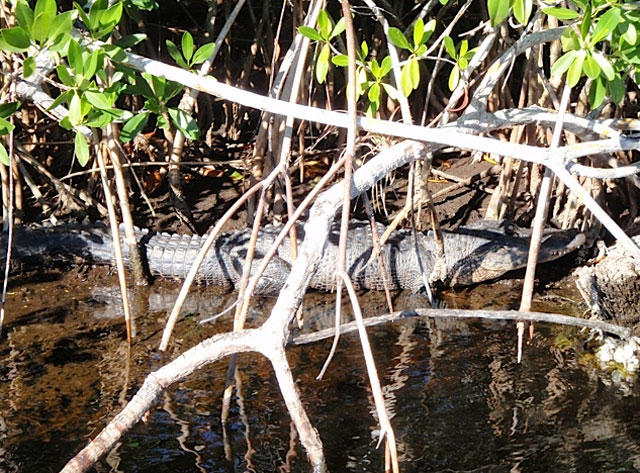
Yes, there really are alligators here. Within a few feet of where I plan to sleep. In a tent.
Far from civilization in the wee hours of the morning, the debate rages on. At least, it rages for a little while. Then, the thoughts of gators switch to observations of a brilliantly starry sky. Noises in the trees reveal themselves to be a welcome breeze gently rustling the mangroves.
And this city boy realizes there’s a lot more to Florida’s appeal than a cartoon mouse’s overstuffed theme park.
The Other Side Of Florida
The purpose of my visit to the Everglades was to—what else—go boating. In this case, that boating would take place on the Everglades Wilderness Waterway. The idea had been brewing in the mind of friend and fellow boating journalist David Seidman for quite some time. As Seidman pitched it, it would be a trip through a portion of the largest subtropical wilderness in the United States, an area that once stretched from Orlando to Florida Bay. It’s a vast wetlands mixed with mangrove swamps, freshwater sloughs, sawgrass marshes, pine rocklands, and hardwood hammocks. It’s also home to no less than 36 protected or threatened species, including the Florida Panther, the West Indian Manatee, and the American Crocodile.
Intriguing fact: the Everglades is actually a river, a “river of grass” in the words of famed journalist Marjory Stoneman Douglas. It flows southwest at the rate of about a quarter mile per day.
Florida’s rapid development, however, threatens this river. It began in 1882, when parts of the region were first drained for agricultural and residential use. Decades later, the natural water flow of Florida’s mighty Lake Okeechobee was diverted from this so-called “worthless swamp” to help sustain the area’s explosive growth. An extensive canal-building project began in 1947, further funneling water away. Later that same year the U.S. government set aside a small fraction of the area—1.5 million acres—and designated it Everglades National Park.
Seidman wanted to see some of it, and invited me to come along. In early December, we rendezvoused at the Ft. Myers airport, drove south to Everglades City, and got ready to explore the watery road less traveled.
Two Problems...And 10,000 Solutions
We didn't get off to a very good start. As our first morning dawned and we set out aboard our 16’ skiff, we quickly discovered the tides were not in our favor. It wasn't much of a discovery. Our shallow skiff simply ran aground. Repeatedly. Following a number of attempts to find a navigable path, we also noticed that our GPS had died. After heading back to sort out our problems and start anew, we opted instead to spend day one enjoying another unique area found in southwest Florida, the Ten Thousand Islands.

The Ten Thousand Islands area provided us with deserted beaches and, just as importantly, navigable waters.
In reality a series of several hundred islands that dot the shoreline along the Gulf of Mexico, the Ten Thousand Islands would prove a slightly different take on our journey than the one we initially planned. Rather than an inland trail, it’s a virtual jigsaw puzzle of mangrove islands coupled with pristine, beautiful beaches, along the area’s outer rim. We spent the morning exploring places with names like Jack Daniels Key, ate lunch aboard the boat in the lee of Indian Key, and passed an hour exploring the incredible walking trail that winds through the mangrove roots of Sandfly Key.
Ultimately, we headed back out toward the Gulf and settled on the wide-open deserted beaches of Picnic Key, where a near-perfect wind-carved plateau beckoned for our tent. Some stories around the campfire followed, before we hit the rack (on in this case, the bag) in anticipation of an early start to Day Two.
Observation: our tent proved a little small for two grown men. Still, a campsite directly overlooking the Gulf of Mexico is not too shabby. I mentally cued up some Jimmy Buffett lyrics, listened to the background soundtrack provided by the wind passing through the trees overhead, and soon drifted off to sleep.
And thankfully, Seidman didn't snore.
Isn't This Florida?
Morning dawned clear but unseasonably cool, with a combination of wind and tide still doing their best to keep us from our intended route. So like any self-respecting boating journalists, we improvised yet again. A plan was quickly hatched to make time by running south in the wide-open waters of the Gulf, paralleling the shore until we reached the Broad River, about 35 miles away. At that point we reasoned we could enter the waterway from the south, and explore as we made our way north in more protected waters. We’d miss the southernmost stretch of the Waterway to Flamingo, but given we had already lost a day, options were waning. So we layered on the clothing, donned caps and gloves, and headed south into the Gulf.
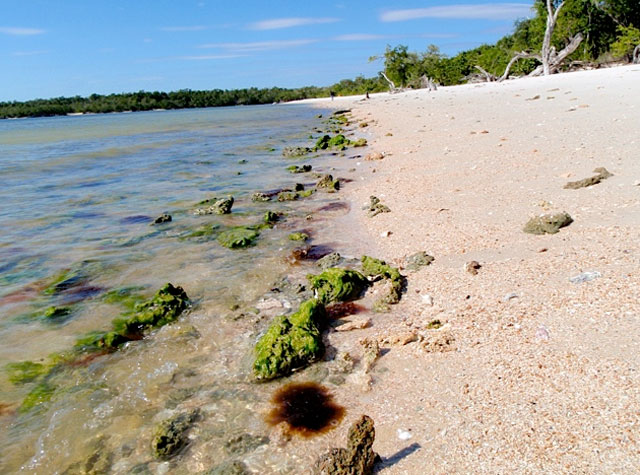
Farewell, sunny beach. We're headed for the Everglades.
It’s important to note that taking a 16’ skiff into the open waters of a windswept Gulf of Mexico is not for the novice. Nor is venturing anywhere in the Everglades unprepared. Accidents happen, boats break down, and help is a long, long ways off. Cell phone reception is minimal at best in this remote corner of the state, and our handheld VHF radio had little hope of hailing the non-existent boat traffic that shared the waters during this quiet time of the year. David and I both have decades of boating experience, but I still wonder if we were foolhardy in our approach. It was bitterly cold, brutally windy, and we had only a sketchy GPS and a cursory knowledge of the boat and motor we were trusting to make the journey. At this point of the season, other boat traffic was also almost nonexistent. Still, this was our adventure, and we were determined to make it happen.
Into The Wilderness
We ran the coast, paper charts in hand and eyes searching for landmarks. Thankfully the GPS cooperated, but the knowledge that it had died once before made certain our concentration never slipped. For hours we headed south, past places like Mormon Key, Alligator Point, and Lostmans River. Occasionally we stopped and drifted, for no reason other than to try and coax some warmth into our fingers and huddle out of the wind. Ultimately we spotted Highland Beach, the landmark that indicated we were within range of our target, the Broad River.
At first, finding the river and actually navigating our way into it proved mutually exclusive, as the seemingly wide-open body of water proved literally inches deep. After several miscues we finally made our way in and turned northeast, along the long-awaited Wilderness Waterway.
First impression: our longed-for escape from the wind wasn't happening. Instead, the breeze funneled down the mangrove walls of the river. Desperate for a respite after hours in the Gulf, we finally sought shelter as the waterway started a series of chicanes leaving Broad River Bay, nestling into the mangroves for lunch. And it was here, sheltered from the wind and with the Florida sun shining overhead, that the trip finally began to resemble what I had imagined.

We may be in Florida, but it's during an epic cold-snap. Even deep in the Everglades, hats and gloves were a must.
To envision the Wilderness Waterway as a narrow trail is a mistake. Yes, there is the occasional narrow cut through mangrove islands, but in actuality the Waterway is more like a path designated by channel markers that leads through a seemingly endless series of wide-open bays, darting in and out behind a multitude of islands that challenge your navigation skills. Or at least demand you pay attention. With David taking his turn at the wheel I became the navigator, searching for markers on the horizon and pointing the way. For the first half of the trip we saw literally no one, just wide-open empty wilderness... and the occasional porta-potti.
Home Away From Home
In a kaleidoscope of aquas, browns, and greens, the bright blue plastic of everyone’s favorite portable rest room stands out in the wilderness like a sore thumb. Or a beacon. As it turns out, those porta-potties are the easiest way to pick out chickees, the raised campsites sprinkled throughout the Everglades.

Chickees are found up and down the trail. Note the ever-present porta-pottie.
A simple wooden platform that sits elevated several feet above the water’s surface, chickees feature a corrugated roof and open sides, offering shelter from the rain while staying airy in the typical Florida heat. They also sit just far enough off the mangroves to limit the amount of mosquitoes that find you at night. Chickees were used by the Seminoles during the Second and Third Seminole War as the tribe retreated deep into the Everglades. Today, they’re a virtual necessity in an area where mangroves, water, and blood-thirsty insects almost completely prevent camping on land.
Chickees come in two versions, single platforms or doubles, the latter connected by a walkway. That means you might have a neighbor across the boardwalk for the night, or you might have your own personal oasis. Either way, that ever-present porta-potti is part of the décor. Considering the remote location, it’s a welcome sight.
I think the absolute best part of a chickee is hanging out on it as the sun dips low toward the horizon. It’s then that the water takes on a mirror-like reflection, the colors grow deep and rich, and the solitude and tranquility of the Everglades really begins to shine through.
Chickees, however, come with a reality check. For starters, fires are not allowed for obvious reasons. That means you can forget firing up the camp stove for a hot meal, or singing songs around the campfire. As you might expect, they also prove rather hard to sleep on; your tent literally sits atop a wooden deck. I wisely brought foam pads to add a layer between my back and the nearest two-by-six. Even then, however, experienced chickee campers warned me I’d awaken to a stiff back. But when you’re watching the sun set off to the west and taking in the magnificent silence, the discomforts don’t seem all that important anymore.
And Now, The Rest Of The Story...
That’s not a bad visual to segue into a neat-and-tidy closing paragraph, but alas, I must confess. With that waning sunset came the most brutal cold we had experienced yet. Florida was in the midst of a record cold spell during our visit, and the bitter grasp of old-man winter stretched into these far reaches of the sunshine state. With the forecast indicating an overnight plunge to 29 degrees, we again changed plans on the fly—and like any good journalists with an expense account, hightailed it the last few miles to the comfort of an Everglades City hotel room.
Where gators wouldn't be tempted to eat me—or spoon with me for warmth.
Read more about the other side of Florida: Going “Back” in Time and Place: the Florida Keys Backcountry