Photo Boat Becomes Billboard
With assignments and resources lacking, photographer Robert Brown needed a way to save his photo boat. A graphics wrap for Kawasaki Watercraft provided the answer.
Most of what I learned during my six years of college—all undergrad of course—I’ve forgotten. But among things that managed to stick in my rattrap of a brain from those days is the term “functional fixedness.” Don’t ask me why.
Functional fixedness is when you see an item as good for just one thing. You pick up a crescent wrench, for example, and see it as only good for tightening and loosening bolts. But in a pinch a crescent wrench can make a dandy hammer. When you see beyond the intended purpose of an object, you realize it can be used for other things. So though in truth a crescent wrench really doesn’t make a “dandy” hammer, it can still be used as one.
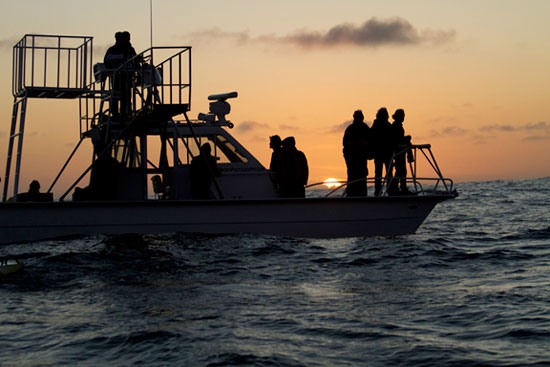
Robert Brown helped design his boat to be the ultimate on-water photography platform.
That’s called overcoming functional fixedness, and that’s exactly what photographer Robert Brown had to do to save the 36-foot-long Twin Vee photo boat he had built in 2006. Brown ordered the boat as the ultimate platform for shooting subjects from high-performance powerboats and personal watercraft to big-wave surfing. He even had Pacific Yacht Towers fabricate custom “wing” extensions from its tower.
“They give me a higher upper angle for shooting boats,” says Brown. “It’s like a ‘poor man’s helicopter angle’ for photography.”
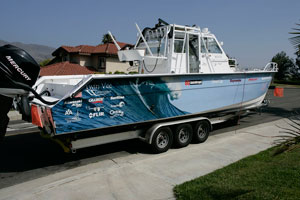
Brown’s original graphics wrap featured one of his big-wave photos to promote his photography business.
At the time, Brown’s investment of nearly $500,000 in the boat made sense. After all, his business, which included shooting for magazines such as Powerboat and Personal Watercraft Illustrated and commercial clients such as Kawasaki Watercraft and Tommy Bahama, was booming. Though his passion is shooting surfers riding immense waves—Brown also is the world’s premier big-wave surfing photographer—personal watercraft catalogue and boating magazine work provided most of his income.
And then it didn’t. Although the past three years have been the toughest in the history of the marine industry, the decline really started a couple of years before that. Commercial work became harder to find. Magazines cut back—hard. And Brown, a pure freelance shooter, eventually found himself with payments on a boat he could no longer afford. Even though television and motion picture production companies had occasionally used his boat for everything from a shuttle to photo platform, it wasn’t enough.
“I put the boat up for sale because no work was coming—so many people had gone out of business and so many were cutting back,” says Brown. “But the bottom line was I couldn’t sell it for what I owed on it. I couldn’t get out from under the existing loan. The only option was to go bankrupt or find a new way for things to improve. So I put my head down and started to look at it differently.”
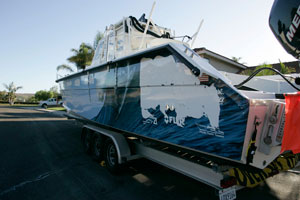
For a television show shoot, Brown had to slice out sponsor logos from his initial wrap.
From shooting big-wave surfing events at famed West Coast surf spots including Mavericks and Todos Santos, Brown, who has won the Billabong Big Wave XXL photo contest four times, knew that his boat captured attention. With its wing extensions attached, it looks like a hybrid of a fishing boat and a fire department rescue-ladder engine. As such, the unique vessel tends to show up well in photographs, as well as on television and in motion pictures. It’s hard to miss.
Brown originally had the boat “wrapped,” a process in which graphics are applied in a single sheet of vinyl on each hull side, with an image created from one of his big-wave photos. Woven into the original wrap were the logos of various manufacturers who had contributed to the boat, such as Mercury Marine, which gave him a discount on its twin 300-hp Verado outboard engines and Pacific Yacht Towers, which built the boat’s unique tower.
During a television shoot, however, Brown had to slice out those logos as they were a no-no on TV. That left him with a hacked-up and frankly ugly wrap job, which he eventually peeled off so that the boat was all white. But that gave him an idea.
What if he marketed the boat itself as moveable billboard? After all, the boat was going to be seen at major surfing contest and personal watercraft events, as well as powerboat and personal watercraft photo shoots, around the country. He was going to be there anyway. His boat was in essence a giant advertising space. What if he sold that space to the highest bidder?
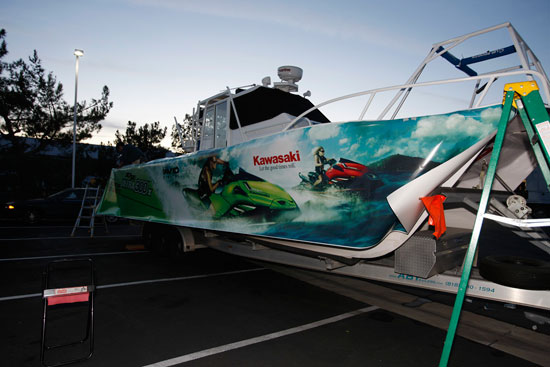
The “wrap” graphics for each hull side of Brown’s photo boat were applied in a single sheet.
So Brown began sending out proposals—and in the late summer Jeff Horton at Kawasaki Watercraft, knowing a good thing when he saw one, jumped at it. The graphics wrap with the Kawasaki name and logo had to be completed in December so it would be ready for the Jay Moriarity Memorial Big Wave Surfing Contest at Mavericks in Half Moon Bay, Calif., which has a waiting period of January through March. (The contest has not happened as of yet.)
Brown is contracted to bring the boat and his new truck, which features a matching Kawasaki wrap, to several events this year. They include the U.S. Open of Surfing in Hungtington Beach, Calif., and the International Jet Sports Boat Association Personal Watercraft World Championships on Lake Havasu in Arizona. The boat also will log significant time at Catalina Island and Newport Beach this summer.
Created by Avid Digital in Irvine, Calif., where Kawasaki also is headquartered, the wrap is for all intents and purposes a big sticker—one for each side of the boat. Protecting the wrap from scrapes and scratches, as well as the elements, is a heat-applied plastic coating. According to Brown, applying the wrap is something of an art.
“It’s really kind of amazing,” said Brown. “It takes just two guys to do it. They start at the rub rail and kind of roll it down. They use propane torches to heat it so they can stretch it as they go. Honestly, I don’t know how they keep the bubbles out of it—you’re talking about a 36-foot-long, 5-foot-wide single sticker—but they do. I’m blown away by how great it looks.”
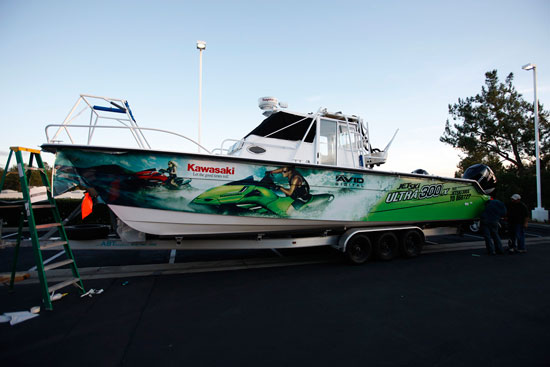
Once applied, the wrap graphics look similar to custom paint.
Cost of the wrap was approximately $4,000, by no means cheap but significantly less expensive—and easier to remove—than a custom paint job.
But for Brown, removal won’t be an issue in 2011. His contract with Kawasaki runs throughout the year.
“I’m really grateful it worked out this way,” said Brown. “The boat will still work as photo platform, but every time it does, every time I go out on a job, Kawasaki will get the advertising and public relations benefit. It’s definitely visible.
“Bottom line, it’s making money even when I’m not working and shooting,” he added. “After the past few years, I can’t tell you how nice that is.”
An excellent example of "functional fixedness."
 Bi-weekly columnist Matt Trulio is the editor at large for Powerboat magazine. He has written for the magazine since 1994. Trulio’s daily blog can be found on speedonthewater.com, a site he created and maintains, which is the high-performance arm of the BoaterMouth group.