Life on the Powerboat Test Team
Juggling a stopwatch, radar gun, and notepad on the water at speeds over 100 mph—it’s all in a day’s “work” for this marine writer.
My friends don’t think I have a real job. At first—say for the first five of the sixteen years I’ve written about the high-performance boat world—that bugged me. Then I learned to accept it. What did they know? They’re not writers.
Now, I relish it, because you know what? They’re right. As a writer for Powerboat magazine, Boats.com, speedonthewater.com and Boatermouth, I realize that I work in the toy store. Yes, I cranked out almost 400 articles last year. Yes, I face a blank laptop screen every morning. “Writer’s block” is a luxury I don’t have.
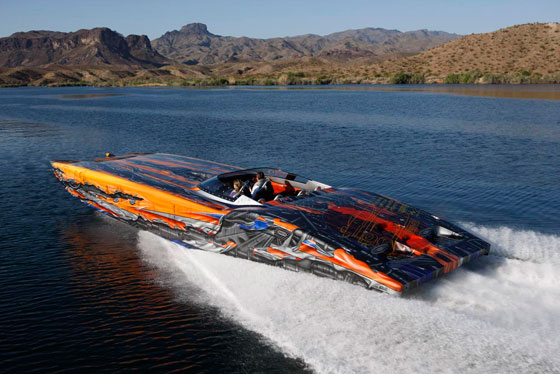
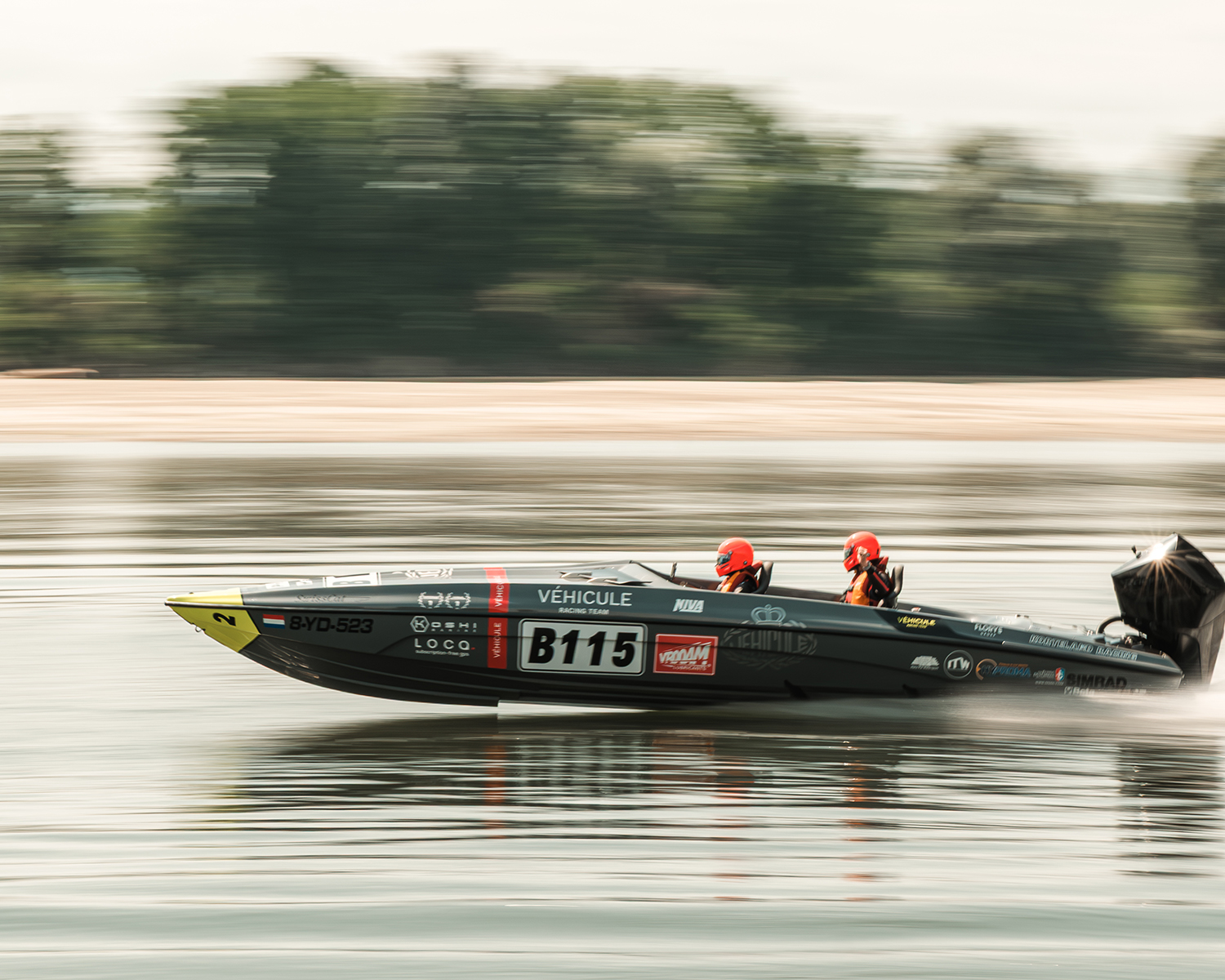
Test driver John Tomlinson pilots Albert Haynesworth’s 48-foot MTI catamaran, Terminator, during a photo shoot on Lake Havasu in Arizona.
But I can pretty much guarantee that my worst day in the office tops your best day in the office, because more often than not my office is a go-fast boat. For sixteen years I’ve been the lead co-pilot, meaning the guy who runs the stopwatch and the radar gun in any go-fast boat evaluated by the Powerboat test team. That means I get to work side by side with test drivers like Bob Teague and John Tomlinson, a couple of multi-time offshore powerboat racing world champions. More qualified performance-boat test drivers do not exist.
In our busiest years, we’ve tested upward of 60 boats at the two or three sites we choose around the country. In leaner times—this year being a perfect example—we test a dozen or so. The number of models we evaluate each year is as much a function of the economy and the high-performance powerboat industry as anything else, hence the current downturn. (The builders bring the boats to our test sites on their dime.) A go-fast boat is the ultimate luxury item. No one has to own one. So the industry is about as far as it could be from recession-proof.
Testing boats is at once objective and subjective, a combination of hard numbers and ratings. Our test days start at dawn with dry-land inspections, when Teague inspects and describes—on tape—each hull, its propulsion package, its paint, tooling work, hardware, and more. Teague rates each boat from 1 to 10 in each category. I chase him around with a test booklet in which I mark down his ratings for each boat.
We break for running shot photography from either a helicopter or photo boat after dry-land inspections. Teague’s workmanship evaluations, in which he inspects and rates every aspect of the boat’s construction and engine rigging, follow. While he’s handling those chores, I inspect, describe, and rate the interior of each boat.
Depending on the number of boats we have to evaluate on a given day—eight is the absolute maximum—those chores take us through mid-morning. Performance evaluations follow.

Performance testing is just one part the Powerboat magazine evaluation program, which includes interior and workmanship inspections.
We work in two test teams, either Powerboat editor Jason Johnson with Tomlinson and Teague with me, or vice versa. We start with efficiency tests, starting with boat’s engines turning 2,500 rpm and recording the speed as we raise the engine speed in 500-rpm increments. We record time to plane, standing start acceleration speeds from 5, 10, 15 and 20 seconds. We put the boats through mid-range acceleration tests such as 40 to 60 mph and 50 to 75 mph as well. And of course, we go for top speed.
The fastest I’ve been is 170 mph in a 31-foot Dave's Custom Boats catamaran with twin Mercury Racing 1,350-hp turbocharged engines. But the ride that felt the fastest—and hands down the scariest—was 145 mph in 25-foot Eliminator catamaran with a supercharged 1,500-hp Paul Pfaff engine. At those speeds, size does in fact make a difference.
Once we’re done gathering speed and acceleration numbers, we put the boats through handling drills. They involve a series of dizzying and sometimes nauseating slalom and circle turns at low, middle and high speeds. If vertigo is anything more than one of your favorite Scrabble words, these drills are not for you.
We finish one boat and then head back to the docks for another. And another. By the time we’re finished, especially on a busy day when we have an early evening photo shoot, it’s nearly dark.
The real work for me, such as it is, is the writing. I have written as many as ten Performance Reports for a single Powerboat issue, and there are only so many ways to say, “The boat was white. The boat was fast. The white boat went fast.”
But you know, even the writing is pretty fun. I knew I wanted to be a writer when I was in second grade, and regardless of what I’m writing about—boat tests were just a fraction of my writing volume last year—I enjoy the creative challenge.
How many people are there in the world who get paid to do what I do? Right now, well, just one.
The more I think about it, the more I know my friends are right. I don’t have a real job. I just have the best one imaginable.
Editor's Note: All photos courtesy Robert Brown Photography
 Matt Trulio is the editor at large for Powerboat magazine. He has written for the magazine since 1994. Trulio’s daily blog can be found on speedonthewater.com, a site he created and maintains, which is the high-performance arm of the BoaterMouth group.