IR2000 - An IRM and IRC Primer
Mark Mills on the new rating rules from RORC
December 16, 2001
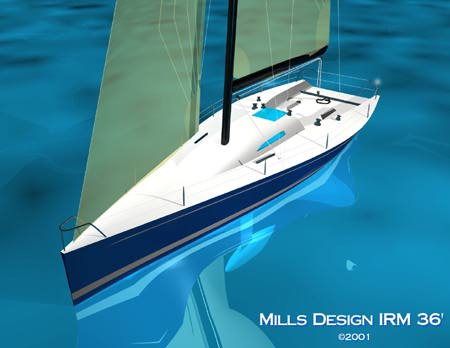
Mills Design IRM 36'
Debates about the future of handicap racing are becoming more common with the decline of IMS and its associated club-level rules Americap and ORC Club. Increasingly the British/French IR2000 rules IRC and IRM are held up as examples of a simple type rule capable of producing results similar to more complex systems at a fraction of the cost and complexity. These two rules provide similar numbers, but arrive at them via very different routes which are worth looking into.
After more than a decade of success with the club-level PHRF equivalent Channel Handicap System CHS the Royal Ocean Racing Club (RORC) launched a new rating initiative IR 2000 to offer two separate rating options, with IRC (Club)continuing CHS for club-level users and IRM (Measured) offering a new more robust system for more competitive fleets sailing at higher levels of competition. The result is that IRC is to all intents and purposes a continuation of the successful and popular CHS, with its core element of 'secrecy'. Although the mathematical elements of the rule are not difficult to tease out with experience, the system is more sophisticated in issuing ratings which account for other less objective variables like past success, campaign budget etc. The strength of this arrangement is reflected in the many users happy with the close competitive racing held under IRC between boats of varied design type and age, but the drawback is that for those owners who feel their rating is inappropriate there is little opportunity for redress, and no objective external review mechanism to police the system. This has been acceptable to the European base of users familiar with the efforts of the RORC Rating Office to keep users happy, but it is easy to see that this confidence might be difficult to maintain in users from further afield.
For those users, especially those racing at a regional or international level, the new IRM rule breaks new ground in a number of exciting ways. Firstly the new rule is simple and transparent enough to put in a Microsoft Excel spreadsheet, and make it publicly available along with the text of the rule on the RORC website on the Internet at www.rorc.org After the basic numbers are entered a single TCF rating is produced, much like IRC. This means anyone with access to a home computer can have a close look at the rule and get involved in their rating and that of others. Secondly since the spreadsheet reveals where the 'Base' values should be for an IRM boat much of the mystery disappears about what design style is favoured by the rule. By accepting that all rules typeform the RORC have decided to promote a lighter, more powerful design type reflecting the current popularity of boats like the Melges, Mumm 30, and 1D35. Introduced in 2000 the rule has produced some excellent racing between some new custom IRM designs and existing designs like the Farr 40 which fit the new rule well.
The rule itself is quite straightforward, using many of the same basic measurements as IRC such as length, beam, draft etc., with the significant addition of an inclining test to measure stability. In the spreadsheet the sailing length L of the yacht is established, from which base figures for all the other variables such as beam, draft, righting moment, and sail area are computed (anyone remember the CCA rule?). The further the yachts actual measurements stray from the base numbers the less optimum the rating, meaning that new yachts will more or less closely follow the IRM base figures leading to fairly closely matched designs of a similar design type.
A major departure for IRM is in this design typeform. The "Base" boat is significantly stiffer, lighter, and has more sail area than the designs we have gotten used to. Because there is no measurement for aft overhang waterlines will extend by something like 6%, with transoms getting closer to the water. Draft figures are in line with many current designs, but the base beam is slightly wider than IMS promoted. Displacement is down to or below IMS standards which in combination with the longer waterline means a lower Displacement to Length Ratio, a measure of weight relative to length. Sail area is up about 5% in real terms, which combined with the lower weight makes for better power to weight ratios.
The largest change in the new rule is found in the 10% to 30% greater stability available to offset the increased sail sail area. This departure from current typeforms opens a number of new avenues to the designer, and poses the core design equation at work in IRM: do you want to use all the stability available, and if so is it better to produce a wider hull or a larger bulb on the keel to reach that target? This leads to either a narrow hull on the waterline with a deep fin and large bulb to offer high stability with low drag, or a wider flat hull with a smaller keel to achieve the same stability with a lighter bulb - both solutions have already been seen on the race course and every designer will have their own solution, but more competition is needed before the optimum typeform emerges.
The other large change is in the relative increase in downwind sail area allowed: it makes masthead spinnakers a near-certainty with a selection of rig types to fly them from. Swept spreader non-overlapping carbon rigs seem the indicated route under the 2001 version of the rule, but there is plenty of scope for more aggressive VOR60 style rigs. The rule dynamic is openly racing oriented, placing a premium on speed and skill, and not on slowing the boats down in the rating games of old. There are no age allowances, time allowances for extra cruising related interior, cockpit, or deck items, or credit for lower tech construction below the rule ceiling. This specifies that smaller boats must be of medium tech construction, while a sliding scale makes higher tech carbon construction more attractive in larger designs.
The largest drawback to IRM is that there are relatively few yachts which meet these criteria at the moment, although the newer Offshore One Designs such as the Mumm 30 and Farr 40 are close to the right type of boat. While that may pose an immediate difficulty with uptake of the rule, in the long term it will produce closer racing in more exciting boats which reflect the popular change towards a simpler sportsboat-influenced design style. Since the outlook for IRM is that it will involve the most aggressive 25% or 30% of current fleets, and that it will take a number of years to develop, these concerns may not be long term obstacles to the rules progress. There certainly has been a great deal of interest from owners willing to build new designs to an objective rule which they can understand and play a role in.
Whatever rule enters widespread use internationally in future, I would be surprised if it didnt integrate many of the core elements of IRM: a simple transparent rule based on a widely disseminated spreadsheet using a single figure time on time system promoting light stiff powerful designs - perfect!
Mills Design Ltd.
Glendale
Kilbride
Co. Wicklow
Ireland
Phone: +353 404 48500
Fax: +353 404 48501
[email protected]
www.mills-design.com