Bluebird K7: The Jet-Powered Hydroplane That Defined Water Speed Records
Donald Campbell's jet-powered Bluebird K7 set seven water speed records.
The history of world water speed records includes significant achievements by the Campbell family. Sir Malcolm Campbell set multiple land and water speed records in the 1920s and 1930s, including a water speed record of 141.74 mph in Bluebird K4 on Coniston Water in 1939.

Sir Malcolm Campbell poses with his rebuilt Campbell-Railton Blue Bird at Brooklands in 1935, ahead of its triumphant run at Bonneville Salt Flats where the 5-ton, 2,350 hp Rolls-Royce-powered machine set a new land speed record of 301.337 mph – the first time any car broke the 300 mph barrier. (A persistent, if unverified, rumor claims the sheer intensity of the attempt led Campbell to relieve himself in the cockpit.) Image by VÉHICULE
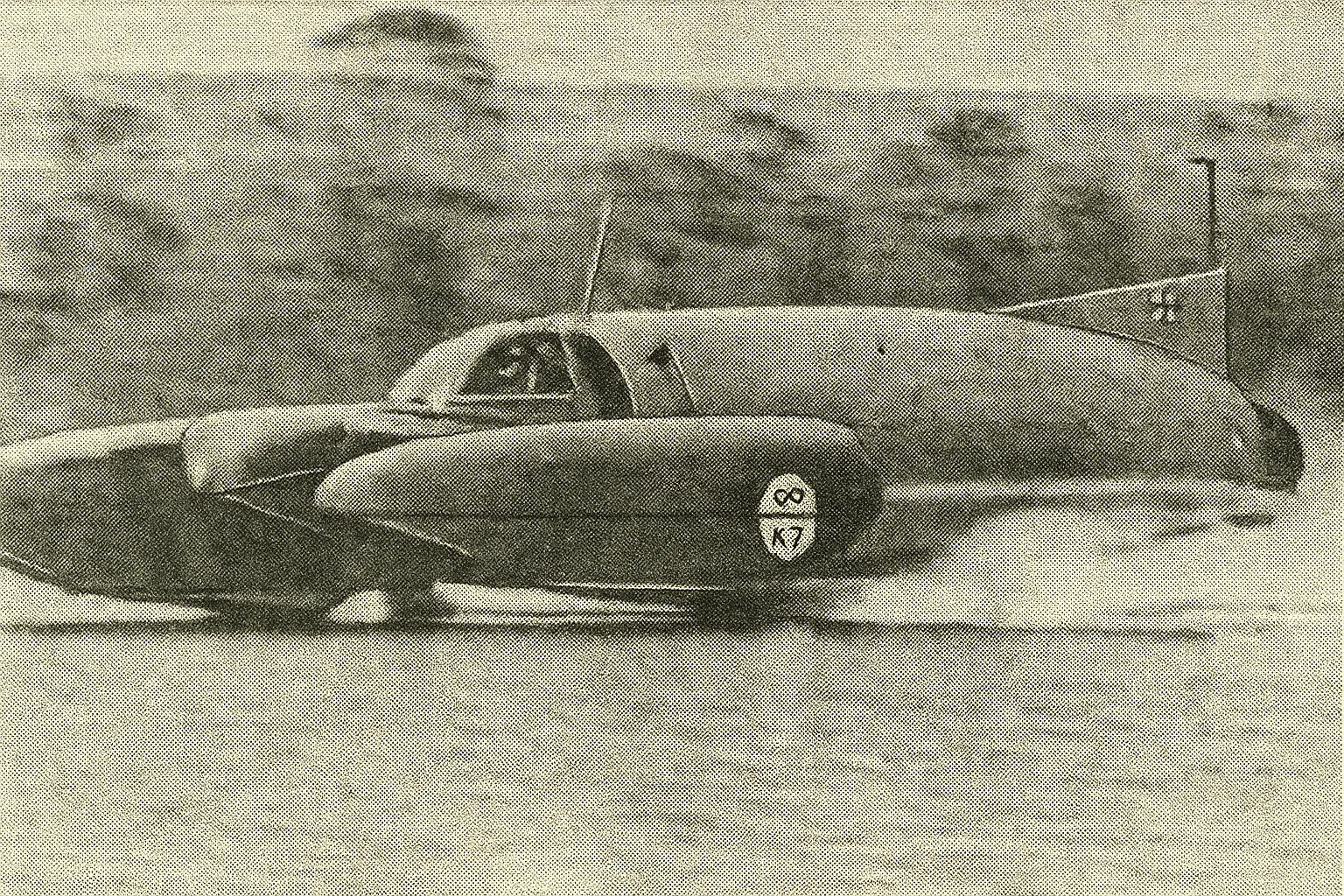
His son, Donald Campbell, continued the legacy. In 1955, he introduced Bluebird K7, the first purpose-built jet-powered hydroplane, designed by Ken and Lew Norris. Powered initially by a Metropolitan-Vickers Beryl jet engine and later upgraded, K7 set seven world water speed records between 1955 and 1964. The final record was 276.33 mph on Lake Dumbleyung, Australia, in 1964. That same year, Donald Campbell also set the land speed record at 403.10 mph in Bluebird CN7, making him the only person to hold both absolute land and water speed records in the same calendar year.

Donald Campbell poses proudly with his revolutionary Bluebird-Proteus CN7 at Lake Eyre, Australia, in 1964. On July 17, the turbine-powered machine carried him to a new land speed record of 403.10 mph – the first wheel-driven car to exceed 400 mph and a fitting successor to his father Sir Malcolm Campbell's legendary Bluebirds. Image by VÉHICULE
On January 4, 1967, during an attempt to break 300 mph on Coniston Water, Bluebird K7 lifted off the surface, somersaulted, and crashed, resulting in Donald Campbell's death.
The wreck remained on the lake bed until 2001, when a team led by diver Bill Smith recovered it. Campbell's body was recovered later that year and buried in Coniston. After legal disputes, Bluebird K7 was gifted to the Ruskin Museum in Coniston. The Bluebird Project, a volunteer effort, restored the hydroplane to running condition over nearly two decades, rebuilding systems to original specifications.
The restored K7 returned to Coniston in 2024. Permission has been granted for commemorative runs on Coniston Water from May 11 to 17, 2026, with speed limits waived for those days only. These will be low-speed passes, not record attempts.
Bluebird K7's jet propulsion and hydroplane design influenced later powerboat development, including aspects of lightweight hulls and high-speed stability seen in modern performance craft. For more on historical record-breakers like Spirit of Australia, which succeeded where Bluebird K7 did not by exceeding 300 mph, see our article on The World's Fastest Powerboats: 5 Famous Record-Breakers.
Discover top modern options in Best Speed Boats of 2024, including models capable of speeds over 100 mph.
Browse current high-performance boats for sale.
For jet propulsion specifics and their advantages in acceleration and shallow water operation, explore jet boats for sale.