B.A.S.S. hosts virus workshop
JACKSONVILLE, Fla. While many questions remain unanswered about the Largemouth Bass Virus, researchers at a special virus workshop last month said they are more confident than ever that the illness
June 20, 2001
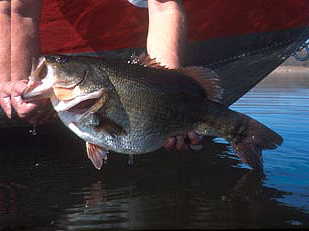
Largemouth bass affected by LMBV may look normal before the disease turns deadly.
JACKSONVILLE, Fla. — While many questions remain unanswered about the Largemouth Bass Virus, researchers at a special virus workshop last month said they are more confident than ever that the illness will not destroy America's bass fisheries.
More than 75 fisheries biologists, pathologists, veterinarians and others from universities and state and federal agencies attended the day-long workshop convened by B.A.S.S., Inc. The workshop was held Feb. 22 in Jacksonville in conjunction with a meeting of the Southern Division of the American Fisheries Society.
The scientists gathered reports showing some largemouth bass died from the virus during 2000, but the number of fish kills remained less than a dozen, nearly the same as 1999. Also, the number of individual bass fatalities with each incident remained relatively small, and no lakes or reservoirs have sustained kills two years in a row.
Largemouth Bass Virus is one of more than 100 naturally occurring viruses that affect fish but not warm-blooded animals. Its origin is unknown, but it is related to a virus found in frogs and other amphibians and nearly identical to a virus isolated in fish imported to the United States for the aquarium trade.
Despite the belief that virus outbreaks are not likely to grow to catastrophic proportions, scientists still want to solve the mystery of what makes the virus turn suddenly from just being detectable into a deadly disease. Such knowledge, they say, could help prevent further outbreaks, an objective that not only would benefit the resource but reassure bass fishermen nationwide.
"Anglers think it's serious, so it's serious," said Phil Durocher, Texas
fisheries chief, in explaining why his state is researching the virus so
determinedly. Texas biologist David Terre said the state has begun a statewide survey of 49 reservoirs. Thus far, bass in only eight of 31 fisheries analyzed have tested positive, with all of them in central or east Texas. Reports will be available pending completion of the lab analysis.
"We obtained the equipment and expertise to test for LMBV (the virus)," Terre said. "Also, we continued our investigation into hatcheries and into the kills on Fork and Rayburn.
"Electrofishing surveys didn't show that populations in Fork and Rayburn
were seriously impacted, but anglers felt the impact. There is no question that tournament catch rates were off. There was a measurable effect on catch rates."
In addition to the Texas Parks and Wildlife Department, leaders in virus research include the federal Warm Springs; Georgia Fish Health Center; Mississippi State University; Auburn University, and Louisiana State University.
At Auburn, scientist John Grizzle and his associates made one of the most
important findings of the year regarding the virus: It can remain viable
in water for at least three to four hours.
"Tentatively, that means you could transport the virus in a livewell," he said.
One of the virus' biggest mysteries has been how it has moved from lake to lake, with fish-eating birds and fishermen both among the suspects. The Auburn
finding reinforces the advice given to anglers by state agencies to empty
all water from livewells, bilges and bait buckets before moving boats from
one lake to another.
The Auburn team also discovered that bass could contract the virus from
guppies experimentally infected, suggesting that transmission also
can occur orally.
Just as big a puzzle as how the virus is spread has been what triggers it to
turn fatal. Stress and warm water have been among the leading suspects.
But last summer, the virus killed fish in Lake George, a 525-acre natural
lake on the Indiana-Michigan border, where the water temperature was no
more than 72 degrees. Before that, the virus kills had been confined to an area
from east Texas to North Carolina and south from Table Rock Lake on the
Missouri-Arkansas border. Scientists had thought the virus might not
threaten fish in more northern waters. But it has.
"There's not a lot of local concern, and we won't start sampling (looking
for presence of the virus in other lakes) unless it starts showing up
(causing fish kills) in other lakes," said Gary Whelan of the Michigan
Department of Natural Resources.
Other kills did occur during 2000 in Arkansas, Oklahoma, and Louisiana.
Probably the most notable was on Lake Monticello, considered by many to be
Arkansas' premiere trophy bass lake.
Arkansas biologist Jon Stein said about 1,000 adult bass, most of them 16 to
24 inches long, died in the 1,400-acre lake from June into September. The
largest found weighed 12 pounds.
"In August, the number of infected bass was at its peak," he said, adding
that fish in lakes Dardanelle and Ouachita also tested positive for the
virus, while fish in Millwood proved negative.
Just across the border in Oklahoma, virus-related kills occurred in
Tenkiller, Grand, Hudson, and Fort Gibson.
But despite drought and low-water conditions that no doubt stressed bass in
many lakes and reservoirs throughout the South last summer, virus die-offs did not increase, workshop attendees emphasized, adding that's the best news of the year.
Research progress has been limited, however, mostly because of financial constraints, they said. Researchers were optimistic that four virus projects
totaling about $500,000 will be funded this year with Federal Sportfish Restoration Funds that have been reverted from the states to the U.S. Fish and Wildlife Service. These are the revenues collected from excise taxes on fishing tackle and motor-boat fuel paid by anglers and boaters.
For more information, contact B.A.S.S. Conservation Department at (334) 272-9530 or via e-mail to [email protected] for more information.