What's Your Angle?
JWorld's John Alofsin on picking the best angle for downwind sailing
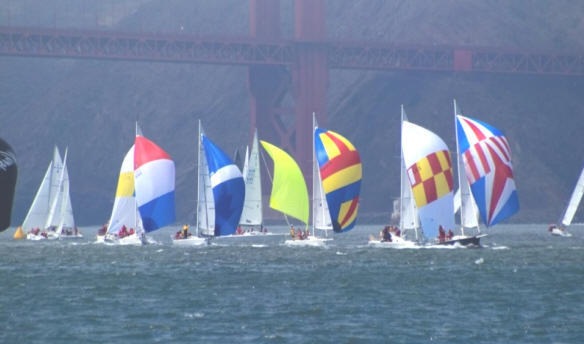 This is the first in a series of Racing Tips from JWorld Sailing School's John Alofsin:
I think it was W.C. Fields who once coined the phrase, "Hey buddy, what's your angle? - Everyone's got an angle." While he wasn't talking about sailing, his question is still a good one for racers. We all should know what our best angle is, especially when sailing downwind.
The trade-off sailing downwind is simple: you can sail farther off the wind and sail a shorter distance to the mark, but your boat speed will be slower. Alternatively, you can sail a higher angle and go faster, but sail a longer distance. Consistently sailing the best angle results in the greatest velocity made good (vmg) to the mark and you arrive sooner. A well known rule of thumb says to sail higher in lighter conditions (to keep up your boatspeed) and to sail lower as the wind builds. However, the range of angles is huge - going from less than 90 degrees apparent in light air, all the way down to more than 180 degrees apparent in very windy conditions. The trick is picking the best angle in changing conditions.
Choosing the proper angle to the wind to sail on a run is definitely more challenging than on a beat. If you master sailing at your best angle you'll find that you've conquered 70 percent of downwind sailing - its that important. When running, the clues to finding the best angle or "groove" are subtle, but there are lots of clues to look at.
Sight, feel & hearing
Most of us race without the benefit of electronic instruments. Our instruments are limited to a Windex, compass and our five senses. We'll start with our senses since they do the same thing as the most sophisticated instruments: they gather information (data) which is then processed by our brain into a useful format just as a computer would.
The three key players involved in selecting a downwind angle are the helmsperson, the spinnaker trimmer and the tactician.
The trimmer is often the first to detect a change in wind strength. A puff will cause the spinnaker sheet to load up and tug on your hands, while a lull will have the opposite effect. The trimmer should tell the helmsperson about any change in feel or pressure. A comment from the trimmer that "I've got good pressure" should result in the helmsperson sailing a lower and more direct angle to the mark. As the boat bears off, the pressure on the sheet will lessen and the trimmer should tell the driver to "hold it there" before the sheet goes too soft. If this warning is ignored and the angle gets too low for the wind strength, the spinnaker will become unstable since there's not enough apparent wind to keep it full, and will eventually collapse. A collapsed chute is the ultimate go slow technique and should always be avoided by paying attention to the clues that proceed it.
If the driver hears the trimmer say he's losing pressure, a higher angle should be considered before too much boat speed is lost. Be sure to make small changes in angle and reevaluate after each. If you bear off too far in a small puff, you'll do more harm than good. I've seen experienced trimmers simply tell the driver to either "heat it up" or to "burn off some speed" without explanation. In a sense, it's the trimmer who really steers the boat downwind, and he does it by feel.
The decisions being made by the trimmer and driver should be backed up by the tactician. Since the goal in a race is to beat the other boats, tacticians should look at other boats to confirm that the best angle is being sailed. If you're consistently sailing lower than the other boats, but not losing too much speed, then your eyes confirm that you're choosing a better angle. If the trimmer keeps telling the driver to bear off in pressure, but your eyes tell you that you're losing ground to the other boats, you need to pass this on so the trimmer can adjust his definition of "good pressure". A tactician should also uses his eyes to look for puffs on the water. If you see a puff or lull coming and tell the trimmer and driver before it arrives, their reaction will be that much quicker and smoother and you'll gain distance.
It's important that the trimmer adjust his definition of "good pressure" to suit the sea conditions. In general, you'll usually need to sail with more pressure (a higher angle) in choppy conditions than in flat water. This extra pressure is needed to keep the boat and sails from wallowing in the waves. Also, in ocean waves, a higher angle (with the resultant boatspeed increase) will sometimes make the difference between surfing and not. Of course, once you catch a wave be sure to bear off and use it to sail down to the mark and increase your VMG. When the wave passes, head back up to power up for the next one.
The helmsperson should be aware of any changes in weather or lee helm. Unless crew members have shifted position, a change in the feel of the helm usually indicates a change in wind strength and the associated change in sailing angle should follow.
I sailed with an olympic medalist for a few years and he always got a haircut before a big regatta. When i asked him why he was so superstitious he said he wasn't. He got a haircut because it let him feel the puffs on the back of his neck sooner and to often sail a little lower than the competition. This unique use of feel gave him an edge on the race course.
Your sense of hearing can help too. Noticing a change in the sound the water makes as it passes by can be important. If the noise level drops, your boatspeed is lower and you should think about heading up in what may be a lull.
When to use a Windex
Your Windex can be used to cross check the data you get from your other "instruments",
but you should not use it as your primary means of determining your angle! The most common mistake i see is a driver who constantly looks up at the Windex while sailing downwind. A small piece of plastic that is 30 feet off the deck and is changing direction with every wave is not a great primary instrument. Only glance at the Windex to confirm that your angle has changed, and then get your eyes back on the road.
However, the Windex can come in very handy when jibing. Teams that develop a good rhythm when sailing downwind often find that jibing disrupts this process and results in a long delay getting back on best angle on the new jibe. This means you lose lots of unnecessary distance each time you jibe.
To avoid this problem use your Windex to visualize your angle to the wind going into the jibe and then quickly match it with a mirror image after the boom comes across. Since you always lose some speed during a maneuver you should actually plan on exiting a jibe on a little higher angle than you entered. The trimmer should expect the extra sheet pressure after the jibe and should work with the driver to get back to a normal angle as soon as the boat is back up to speed. When this is done, go back to your regular communications between the key players.
Many racers don't take the time necessary to develop their downwind skills. As a result, those that do a good job of reading their "instruments" can gain a lot on the offwind legs. Watch the great sailors and you'll see that their use of all tools available and their communication between the key players help them to always sail the best angle and make big gains downwind. You can do the same!
John Alofsin is the president of J World Sailing Schools which offers racing classes at 5 us location. John has won numerous championships in the J/22, J/24 and J/35 classes. You can reach J World at 800-343-2255 or at www.jworldschool.com