Boat Stoves: Alcohol and Propane on Older Boats
Propane stoves are the standard on new boats, but older systems may not meet ABYC standards. Here's how to evaluate yours.
Our J/35 came with an Origo stove and oven – fueled by alcohol in canisters (not pressurized). The stove was a bit of a mess, and we’d probably want a propane stove if we cruised for weeks cooking twice a day. However, it’s simple and avoids the problems that older boats have when their propane system meets a marine surveyor.
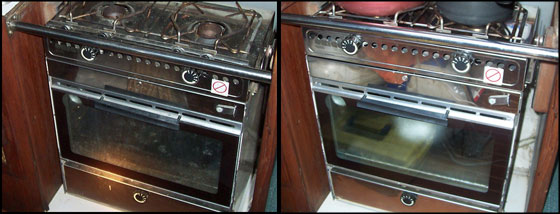
Our alcohol stove, before and after its thorough cleaning and inspection.
These systems may have met industry practices when the boat was built, but leaking propane gas is dangerous enough that no surveyor can ignore a system that is not up to today’s standards. It’s heavier than air, and thus can pool inside the hull – a very dangerous situation. Let’s take a look at common ways that propane systems run afoul of the American Boat and Yacht Council (ABYC) Standards, and then what we did to refurbish our alcohol stove. We can’t get into all of the ABYC standards, but these are common ones from section A-1. A full copy of ABYC's section A-1 can be purchased from ABYC.

If propane tanks are mounted in a dedicated locker recessed in the deck, make sure fumes can't escape into the hull interior.
Propane Tanks and Lockers
ABYC standards call for propane tanks to be mounted in dedicated lockers, or on a weather deck where leaking fumes will go overboard. This brings up a gray area for older boats, where a common approach has been to mount the propane tank aft in the cockpit, in a semi-enclosed spot. In this case, one could argue that any escaping propane fumes (which are heavier than air) will drain overboard through the cockpit drains, and will not enter the cabin - as long as the companionway opening is well above the cockpit sole. While this does not meet the letter of the ABYC standards, some surveyors may feel that it meets the intent. But what if the cockpit drains exit below the waterline, or do not exit at least 20” from other hull openings (also recommended by ABYC)? In that case, there is definitely a problem.
If the tank is mounted in a dedicated locker recessed in the deck, the key thing again is that no fumes be able to escape into the hull interior. All points where LPG hose exits the locker must be sealed, and the locker must be above the waterline so it can have a drain at the bottom that is plumbed overboard to remove any stray fumes. Finally, the drain hose can’t have a dip in it that might fill with water and block LPG gas from flowing out of the boat.
Tanks also need to be securely mounted, and upright - unless they are specifically designed to be on their sides. You don’t want liquid propane reaching the valve or the lines!

Tanks should be upright, unless they are specifically designed to be on their sides.
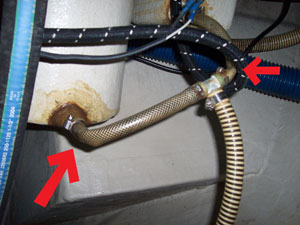
Propane locker drain hoses kinked and led uphill could trap water and stop leaking gas from escaping.
Regulators, Gauges and Leak Checks
A regulator is a must; the pressure of the gas in the tank is around 100 PSI, and needs to be reduced to around .5 PSI for use in appliances. A pressure gauge needs to be installed as well, between the tank and the regulator. The gauge isn’t there to tell you how much propane you have in the cylinder; it’s for leak-checking the system. A leak check is simple to perform – just open the solenoid valve and the valve at the tank to pressurize the system with all appliances off, and close the valve at the tank again. Then note the pressure on the gauge. ABYC recommends a three minute test, during which the pressure should not drop with all of the lines pressurized. If the pressure drops, you have a leak, and things get a little more involved – to find it, you’ll need to check the fittings with a mild soap solution. ABYC recommends avoiding soap with any ammonia in it, because that attacks brass fittings. And for those who enjoy a little dark humor, the standards also say, “Never use a flame to check for leaks.”

A long list of sins here: string support, hose clamps, rusty shut-off valve.
Gas Lines and Connections
To further prevent leaks, all tee fittings need to be inside the propane locker. This means that if your propane tank is feeding two different appliances, the initial connection to those two lines has to be inside the propane locker so that any leaks at the connections will be contained and drained overboard, rather than collecting in the bilge. Therefore, it’s unacceptable to run one propane line forward from the locker and tie several appliances into it somewhere in the main cabin.

Cleaning our old alcohol stove at home became a family project.
The lines must be supported well, continuous from the locker to the appliance, and either be hose that complies with UL 21, with permanent end fittings (not hose clamps), or copper tubing with flare fittings. If it’s copper, it can have one connection to a flexible hose section if it supplies a gimbaled stove.
Emergency Shut-offs
The standards also call for a manual or electric shut off valve. This must be at the tank (so that it will be upstream of any leaks), and must be operable from the vicinity of the stove. A solenoid valve in the propane locker with a clearly marked breaker on an electrical panel near the stove is fine for this. A better approach is to install a propane fume detector, and use the manual “off” switch to control the solenoid. Either way (more dark humor) ABYC recommends that the control “shall be operable without reaching over the top of any open flame appliance.”
Back to Our Simple Stove
In our case, I was happy not to have to upgrade an older propane system. In fact, an alcohol stove is a viable alternative for anyone who would rather not deal with a propane system onboard. We pulled our oven off the boat, and made it a family project to clean it at home. There were some stubborn, corroded bolts, but no complicated parts, and it cleaned up well. One caution is that you’ll be sure to find some sharp edges on the sheet metal parts if you really get into the cleaning.
Editor's Note: This story is part of a series on buying a used J/35.
 Paul Grimes is an engineer and marine surveyor living in Portsmouth, RI. For more information, visit the Grimes Yacht Services website.